by
Donald Prothero, Jul 23 2014
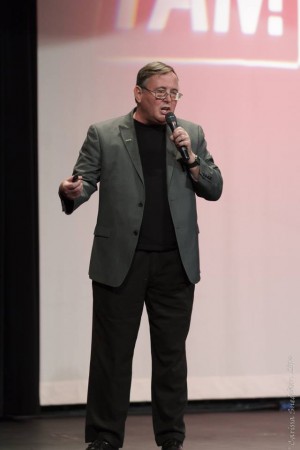
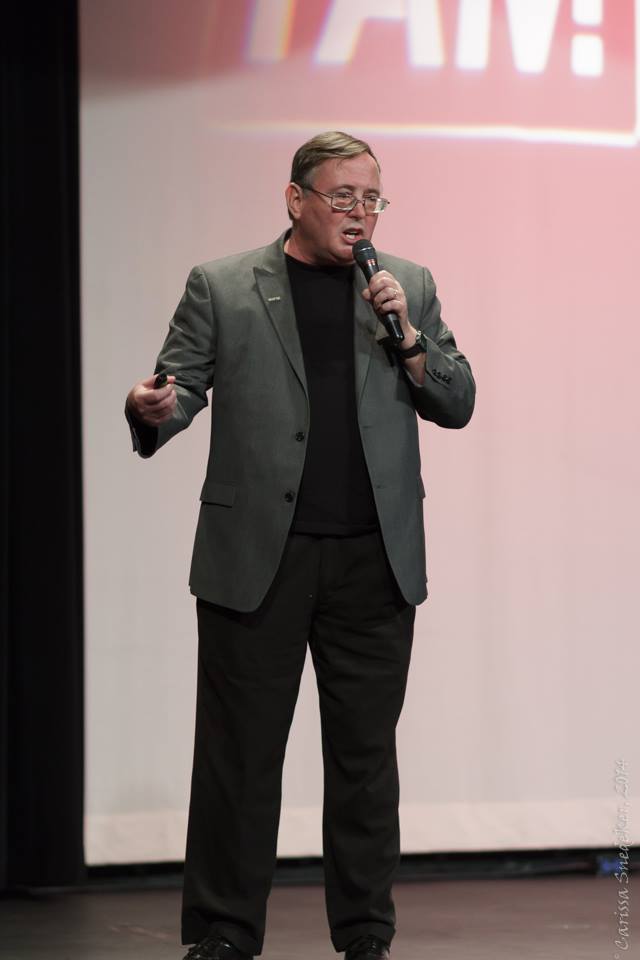
Speaking at TAM on July 13, 2014
It’s been just over a week since I returned, exhausted but inspired and excited, from The Amaz!ng Meeting 2014 in the South Point Hotel south of Las Vegas. The meeting was a great success, with nearly 1200 attendees, and an excellent slate of speakers including Bill Nye the Science Guy (who talked about his debate with Ken Ham and gave me a nice shout-out for helping him), Genie Scott, Daniel Dennett, Michael Shermer, and many others. This year, the theme was “Skepticism and the Brain,” so the speakers including a lot of the leading lights of psychology and neurophysiology, including Elizabeth Loftus (who has shown that human memory is highly unreliable, and usually false), Robert Kurzban (talking about the modular mind), Carol Tavris (talking about cognitive dissonance), and many others. My friend and co-author Daniel Loxton gave an amazing talk about skepticism and why it’s important (it got rave reviews and a standing ovation). Many of the participants thought that this was one of the best TAMs ever, because it largely stuck to a consistent theme, rather than giving a scattershot slate of speakers on widely divergent topics. Plus there were the usual wild evening activities, including another installment of Penn Jillette’s inimitable Rock’n’Roll, Doughnut and Bacon party. Continue reading…
comments (13)
by
Donald Prothero, Jul 02 2014
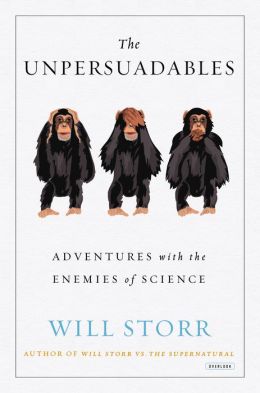
A review of The Unpersuadables: Adventures with the Enemies of Science, by Will Storr (2014, Overlook Press, New York).
Most of us long-term skeptics have had our share of run-ins with people who cling stubbornly to a particular dogma. We get frustrated that no amount of evidence or strong arguments ever changes their point of view. The pattern is true whether you’re dealing with religious beliefs (from creationism to various Eastern religious ideas), or paranormal beliefs (UFO nuts, psychics, ghosts, cryptozoology) or just plain pseudoscience and bad scholarship (homeopathy, past-life regression, Holocaust deniers, climate-change deniers, and many others). Reporter Will Storr decided to go deep into the heart of these various fringe and non-scientific belief systems, interviewing the major figures, taking part in their rituals, and doing his best to give them a fair shake as he embeds himself into their culture. Continue reading…
comments (10)
by
Donald Prothero, Jul 17 2013

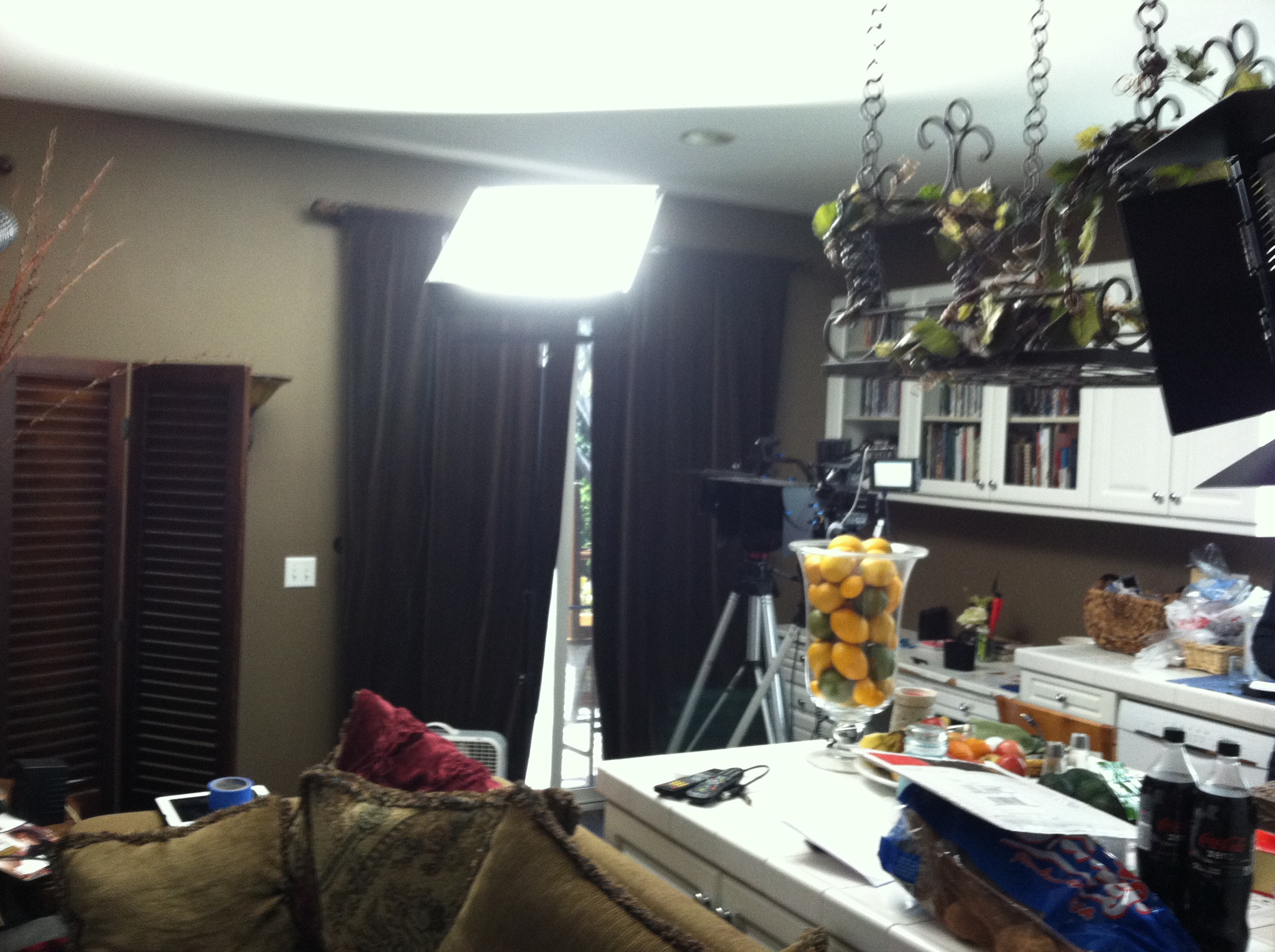
The “soundstage” of Mr. Deity: cameras and lights crammed into the kitchen, shooting into the living room
Almost two months ago, I had the opportunity to be part of the latest episode of the hit YouTube series, “Mr. Deity”. For those who have not seen this hilarious series of 3-minute episodes before, you can go to MrDeity.com, and most of the previous 5 seasons are freely available on line. The entire production is the brainchild of one man, Brian Keith Dalton. Brian writes the scripts, plays the main role as “Mr. Deity” (of which religion he does not specify), films all the episodes by himself with minimal help, then edits all the digital files to produce a tight, funny, fast-paced mockery of the sillier aspects of religion. As Brian has explained, the use of humor and gentle satire can be much more effective tool to get people to examine the absurdities of their religious dogmas than angry confrontational approaches. The “Mr. Deity” character is no awesome Jehovah, but instead a sloppy, feckless, distracted deity who doesn’t worry about details, and gets mad when humans misinterpret him. He constantly finds himself entangled in the complex web of confusion and contradiction that is the essence of religious dogma. After watching a few episodes, you will find that Brian’s scripts are uniformly laugh-out-loud funny as he and the other characters wrestle with this messed-up world of religion. The cast often includes Amy Rohren as “Lucy”, or Lucifer the Devil; Sean Douglas as “Jesse” or Jesus; several other minions of Heaven, such as filmmaker Jimbo Marshall as “Larry”, the manager, who do the dirty work that Mr. Deity has no time for; and noted skeptic Jarrett Lennon Kaufman as Timmy the Tech Advisor. There is often a guest skeptic who plays a straight man for Mr. Deity’s sendup of the inanity of each religious idea. Some of these past guests have included Michael Shermer of the Skeptic Society, P.Z. Myers of the Pharyngula blog, skeptic and magician Jamy Ian Swiss, Carrie Poppy of the “OhNo, It’s Ross and Carrie” podcast, and a number of other skeptics and non-believers.
I got to know Brian during a Skeptic Society field trip in January 2012, and he said that he wanted me to be part of a future episode. After some illnesses, and trying to get our busy schedules coordinated, we finally managed to film in May 2013. He sent me the script, and I tried memorizing the lines and learning how to act them. Though I’ve memorized scripts before, I haven’t performed in a play since I was 12 years old. I’ve always been a good memorizer, yet I found it surprisingly hard to master my lines, despite days of rehearsal. Most of my past appearances on camera were to give academic lectures or appear on prehistoric animal documentaries, where I ad lib the lines rather than memorize them. Continue reading…
comments (2)
by
Donald Prothero, May 08 2013
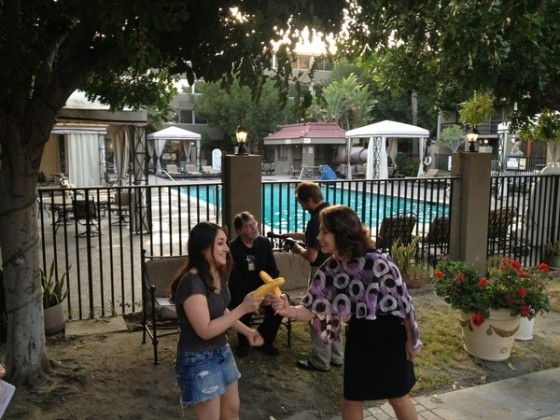
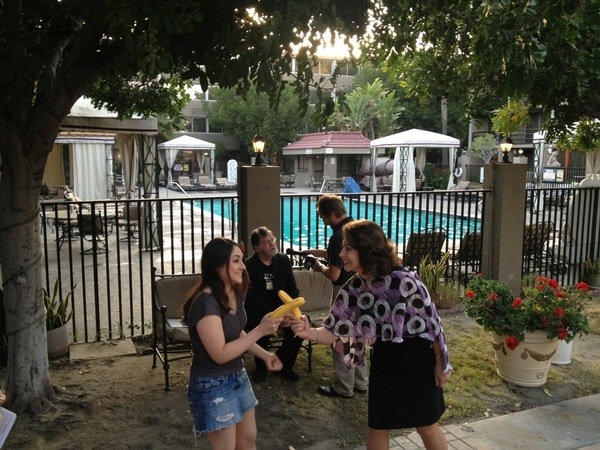
The surreal sight of Margaret Downey and Jessica Ahlquist dueling with bananas in the foreground, while evangelist Ray Comfort interviews P.Z. Myers in the background
“Letting a hundred flowers blossom and a hundred schools of thought contend is the policy for promoting progress in the arts and the sciences”
—Mao Zedong
Last weekend I had the privilege of speaking at the Orange County Freethought Alliance fourth annual conference. Although I’ve spoken at The Amazing Meeting (this coming July will be my third such time), and frequently at the Skeptic Society meetings over the years (my “home base”), and made the big AAI meeting when it was in Burbank in 2009, this was the first of the smaller regional meetings in California that I had ever attended. I’m familiar with big events like TAM, with its lineup of all-star speakers and gigantic ballroom crammed with over 1600 people, so this smaller local meeting with about 300 participants was a nice change of pace. The venue was a smaller convention/ ballroom facility in the Fullerton Howard Johnson’s hotel. We were in the heart of Orange County, long the most conservative place in all of California. Since we were just blocks away from Disneyland, as you walked in that morning there was a continuous flood of tourists (mostly Asian) headed out for The Magic Kingdom. Yet the weather was nice (after a record-breaking heat wave on Thursday and Friday), the sun was out, and the swimming pool beckoned to our speakers who had flown from cold and snowy Minnesota or Philadelphia.
I got there much earlier than necessary (I never take chances on LA traffic, and since I was a morning speaker, I wanted to make sure my talk was working properly). The organizer, Bruce Gleason, had done a remarkable job with his small cadre of volunteers running the registration table and badges, handling the AV, manning the exhibitors’ booths in the back, and assigning one volunteer to be the speakers’ “go-fer” and another to give us warning on how much time we had left. The meeting price included catered lunch and dinner buffet style, which was excellent, and very efficient in feeding a large group and getting them back quickly. Continue reading…
comments (5)
by
Brian Dunning, Nov 29 2012

A hint from the Illuminati
This week my Skeptoid podcast episode was on the history of the Flat Earth Theory. By now most everyone knows that there really wasn’t a time when any governmental or scientific authority actually believed the Earth was flat, and most of us also know about the existence of a Flat Earth Society. But there is a fascinating, and sometimes quite dramatic, intertwinement of the two.
As I discussed, Flat Earthers have, for as long as they’ve been a movement, been of two basic varieties. There are the Biblical literalists who interpret certain Bible passages to mean the Earth is flat, and consider science to the contrary to be blasphemous. The second type consists of alternate science conspiracy theorists, cranks who think they’ve overturned Newton’s laws, and who point to the United Nations flag as a hint from the Illuminati as to the true shape of our world.
Continue reading…
comments (17)
by
Daniel Loxton, Oct 03 2012
Back in August I noticed with some surprise that a new network of skeptic and atheist bloggers had started up at Skepticblogs.com. (Surprised, because I had thought we owned that domain. When Skepticblog, our own skeptical group blog formed back in 2008, we made sure to snap up all the variations on our name that we could get our hands on. However, it seems that Skepticblogs.com was not then available, and therefore got missed.)
Hypatia of Alexandria, the inspiration for Skeptic Ink. Artwork by Ryan Grant Long
Looking at the new site, it seemed to us that two group blogs with such similar names (just an “s” apart) and overlapping (though not identical) rationalist missions could create confusion and headaches for both sites. Happily, we were swiftly able to sort things out with the organizers of the new blog, thanks to their very neighborly approach: they relocated to a new domain, and we did what we could to help.
So I’d like to extend my heartfelt thanks to the whole crew over there for their community-minded kindness and assistance, and introduce you to the relocated, rebranded, and redesigned Skeptic Ink blog (aka, the Skeptic Ink Network, or more playfully, SIN). I see that it is home to an energetic mix of different voices, each touching on different facets of a wide rationalism — not only the scientific skepticism that is Skepticblog’s area of concentration, but also atheism, philosophy and related topics they deem “vital to human flourishing.”
I hope you will check out Skeptic Ink, and join me in thanking them for their collaborative spirit.
comments (15)
by
Daniel Loxton, Sep 04 2012

On the road in Alberta, Canada.
Howdy, folks! It’s been a while since my last post. I’ve been buckled down hard under deadlines for my next two books (the followup to my children’s paleofiction book Ankylosaur Attack; and my hefty skeptical tome with Skepticblog’s own Don Prothero, Abominable Science). But now that I have the chance, I thought I might stop in with a few personal thoughts before jumping back in with more new posts. Continue reading…
comments (9)
by
Donald Prothero, Jul 18 2012
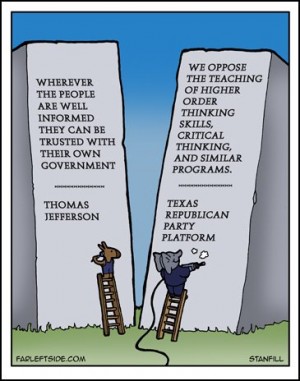
No matter what our political or religious persuasions in the skeptical community, we all hold to some basic ground rules of skepticism. We all agree that critical thinking and questioning authority is a good thing, that humans are easily misled into all sorts of errors of logic, and that it’s easy for any of us to be fooled. Many of our skeptic books are largely about the topic of critical thinking, and the recent efforts by the Skeptic Society to promote critical thinking courses in colleges and universities across the nation are just part of this. Every meeting of CSI, JREF, and other skeptical organizations remind us that critical thinking and questioning authority are essential to getting past the garbage that clutters human thinking and behavior.
In emphasizing critical thinking, we are fully aware that there are powerful organizations (especially religious and some political organizations) that don’t want us to think critically, don’t want us to ask questions, don’t want us to challenge their authority. Many of us are deeply involved in battling religious interference in science and science education, or political interference in scientific and educational decisions made by organizations with clear agendas that don’t stand up to critical scrutiny. Many of us were raised in Sunday School classes where we asked tough questions and were told to shut up, or to stop disrupting class, or something to avoid the fact that the Sunday School teacher had no good answer for that question. We can imagine powerful politicians and their people chatting among themselves privately that those damned skeptics keep messing things up, and we have to stop their interference. Continue reading…
comments (59)
by
Michael Shermer, Jul 03 2012
Or: What it was Like Teaching a Course in Skepticism 101?

On March 31, 2011, I debated Deepak Chopra at Chapman University on “The Nature of Reality” that also featured Stuart Hameroff, Leonard Mlodinow, and several other commentators, all choreographed by the Chancellor of Chapman University, mathematician Daniele Struppa. In the greenroom before the debate Dr. Struppa was reviewing my bio and noted that I am an adjunct professor at Claremont Graduate University and made a comment that I should be an adjunct professor at Chapman as well. I said something like “sure, why not?” and when he introduced me on stage he said something about how I might also one day teach there. Daniele said I could teach anything I want as part of their Freshman Foundations Courses, so I suggested a course on Skepticism 101, or how to think like a scientist (without being a geek). I taught it the Fall semester of 2011 to 35 incoming Freshman students and it was a blast.
During the semester I hatched the idea that since the Skeptics Society is a 501(c)(3) nonprofit educational organization specializing in science education, that we should organize all the course materials that professors and teachers around the world are already utilizing. That is, as I was developing my own course materials I remembered all the requests we had received over the years at the Skeptics Society from educators to reprint articles from Skeptic magazine or use videos of our Distinguished Science Lecture Series at Caltech. There are, in fact, hundreds and hundreds (maybe thousands) of such courses that go under various names that involve skepticism, science and pseudoscience, science and the paranormal, psychology and parapsychology, the psychology of belief, the history of science, the philosophy of science, science studies, critical thinking, and the like. As I went digging through our own webpage Skeptic.com and surfed the Net for other teacher’s webpages in search of good teaching materials, we thought it might be good to invite people to submit their course syllabi, lectures, Powerpoint and Keynote presentations, videos, student projects, reading lists, and the like, which we just launched last week.
EXPLORE THE SKEPTICISM 101 RESOURCE CENTER
Thanks to the support of my good friend Tyson Jacobsen I was able to hire an outstanding graduate student, Anondah Saide, to organize the Skepticism 101 program for us, which began with her TAing the Skepticism 101 course at Chapman University. Anondah was one of my graduate students at Claremont Graduate University who conducts research into the sociology of pseudoscience and the paranormal, and she has a deep interest in education and how to teach students to think critically about the paranormal and the supernatural, so she was a perfect fit for the class and this program. Continue reading…
comments (26)
by
Michael Shermer, Mar 27 2012
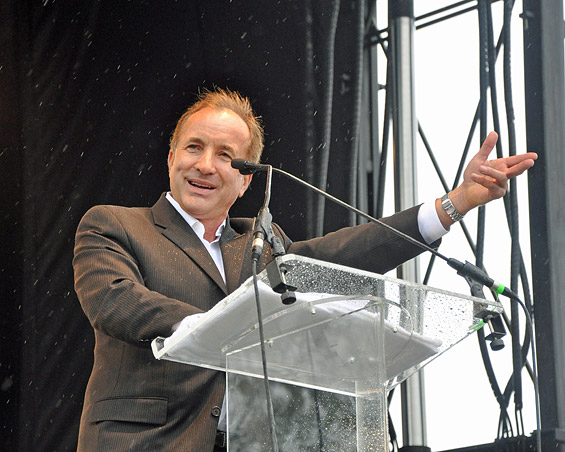
Yours truly, leading the Reason Rally Cheer (photo by John Welte)
March 24, 2012 marked the largest gathering of skeptics, atheists, humanists, nonbelievers, and “nones” (those who tick the “no religion” box on surveys) of all stripes on the Mall in Washington, D.C., across from the original Smithsonian museum. Crowd estimates vary from 15,000 to 25,000. However many it was, it was one rockin’ huge crowd that voiced its support for reason, science, and skepticism louder than any I have ever heard. Anywhere. Any time. Any place. It started raining just as the festivities gathered steam late morning, but the weather seemed to have no effect whatsoever on the enthusiasm and energy of the crowd…or the speakers and performers. The organizer and host David Silverman and his posse of tireless staff and volunteers pulled it off without a hitch. Organizing big events can be an organizational nightmare, but they did it, marking what I hope is the first of many consciousness raising events in the civil rights movement for equal treatment for us nonbelievers and skeptics. Continue reading…
comments (42)