SkepticBlog is a collaboration among some of the most recognized names in promoting science, critical thinking, and skepticism. Regular bloggers include: Brian Dunning, Daniel Loxton, Donald Prothero, Mark Edward, Michael Shermer, and Steven Novella. This site is hosted by the Skeptics Society.
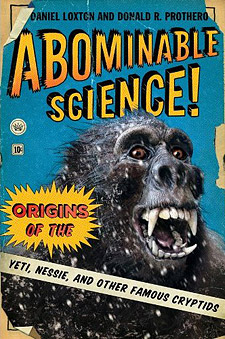
For our new book on cryptozoology, Daniel Loxton and I delved deeply into the psychology of those who believe in Bigfoot and Nessie and the rest. What about these people who believe in cryptids? What can we say beyond the anecdotal descriptions of the Bigfoot subculture that I discussed in my August 28 post? There are actually large-scale rigorous studies that have been done to see what the population as a whole, and what kinds of people in particular, think about paranormal topics. The most famous is the Baylor Religious Survey, a huge data set of multiple choice questions collected almost each year since 2005, which looks not only at beliefs, but also at the demographic data behind them. If you look for the questions that mention cryptids like Nessie and Bigfoot, you can get a sense of how widely these ideas are held in the sample of hundreds of people included in the survey. For example, about 17% of the people in the sample agreed or strongly agreed with the statement: “Creatures such as Bigfoot and the Loch Ness Monster will one day be discovered by science,” while about 56% disagreed or strongly disagreed (27% were undecided). About 20% said “yes” to the question: Have you ever read a book, consulted a Web site, or researched the following topics: Mysterious animals, such as Bigfoot or the Loch Ness Monster? The highest percentage of those people who agreed with cryptozoological ideas were young (18-30) single white males with only a high-school education or less, lower incomes, but who do not tend to be very religious, either.
In their book Paranormal America, Bader et al. (2011) point out that belief in the paranormal is held by about two-thirds of Americans, and the average American holds at least two paranormal ideas to be true. In other words, most Americans believe in the paranormal, making it the norm in our culture. The skeptics and non-believers are the minority, the “abnormal ones”.
Foreigners could be forgiven for thinking that America is fast becoming a theocracy. No fewer than three of the remaining Republican candidates (Rick Perry, Rick Santorum, and Michele Bachmann) have declared that they were called by God to run for the country’s highest office. Congress recently voted to renew the country’s motto of “In God We Trust” on nothing less than the coin of the realm. And this year’s Thanksgiving Forum in Iowa (co-sponsored by the National Organization for Marriage) featured most of the major Presidential candidates competing for the title of God’s quarterback.
Rick Santorum, for example, in the course of denouncing Islamic Sharia law, inadvertently endorsed the same as long as it is a Christian on the Judge’s bench: “Unlike Islam, where the higher law and the civil law are the same, in our case, we have civil laws. But our civil laws have to comport with the higher law.” Not content to speak in such circular generalities, Santorum targeted his faith: “As long as abortion is legal—at least according to the Supreme Court—legal in this country, we will never have rest, because that law does not comport with God’s law.” God’s law? That is precisely the argument made by Islamic imams. But Santorum was only getting started. “Gay marriage is wrong. The idea that the only things that the states are prevented from doing are only things specifically established in the Constitution is wrong. … As a president, I will get involved, because the states do not have the right to undermine the basic, fundamental values that hold this country together.” Christian values only, of course. Continue reading…
Has there ever been a time when the political process has been so bipartisan and divisive? Yes, actually, one has only to recall the rancorousness of the Bush-Gore or Bush-Kerry campaigns, harken back to the acrimonious campaigns of Nixon or Johnson, read historical accounts of the political carnage of both pre- and post-Civil War elections, or watch HBO’s John Adams series to relive in full period costuming the bipartite bitterness between the parties of Adams and Jefferson to realize just how myopic is our perspective.
We can go back even further into our ancestral past to understand why the political process is so tribal. But for the business attire donned in the marbled halls of congress we are a scant few steps removed from the bands and tribes of our hunter-gatherer ancestors, and a few more leaps afield from the hominid ancestors roaming together in small bands on the African savannah. There, in those long-gone millennia, were formed the family ties and social bonds that enabled our survival among predators who were faster, stronger, and deadlier than us. Unwavering loyalty to your fellow tribesmen was a signal that they could count on you when needed. Undying friendship with those in your group meant that they would reciprocate when the chips were down. Within-group amity was insurance against the between-group enmity that characterized our ancestral past. As Ben Franklin admonished his fellow revolutionaries, we must all hang together or we will surely hang separately.
In this historical trajectory our group psychology evolved and along with it a propensity for xenophobia—in-group good, out-group bad. Thus it is that members of the other political party are not just wrong—they are evil and dangerous. Stray too far from the dogma of your own party and you risk being perceived as an outsider, an Other we may not be able to trust. Consistency in your beliefs is a signal to your fellow group members that you are not a wishy-washy, Namby Pamby, flip-flopper, and that I can count on you when needed. Continue reading…
According to a 2009 Harris Poll of 2,303 adult Americans, when people are asked to “Please indicate for each one if you believe in it, or not,” the following results were revealing:1
82% believe in God
76% believe in miracles
75% believe in Heaven
73% believe in Jesus is God
or the Son of God
72% believe in angels
71% believe in survival
of the soul after death
70% believe in the
resurrection of Jesus Christ
61% believe in hell
61% believe in
the virgin birth (of Jesus)
60% believe in the devil
45% believe in Darwin’s
Theory of Evolution
42% believe in ghosts
40% believe in creationism
32% believe in UFOs
26% believe in astrology
23% believe in witches
20% believe in reincarnation
Wow. More people believe in angels and the devil than believe in the theory of evolution. That’s disturbing. And yet, such results should not surprise us as they match similar survey findings for belief in the paranormal conducted over the past several decades.2 And it is not just Americans. The percentages of Canadians and Britons who hold such beliefs are nearly identical to those of Americans.3 For example, a 2006 Readers Digest survey of 1,006 adult Britons reported that 43 percent said that they can read other people’s thoughts or have their thoughts read, more than half said that they have had a dream or premonition of an event that then occurred, more than two-thirds said they could feel when someone was looking at them, 26 percent said they had sensed when a loved-one was ill or in trouble, and 62 percent said that they could tell who was calling before they picked up the phone. In addition, a fifth said they had seen a ghost and nearly a third said they believe that Near-Death Experiences are evidence for an afterlife.4 Continue reading…
The following article originally ran in the Wall Street Journal on Saturday, May 14, one week before Judgment Day is to arrive. The following essay is a longer and more detailed version of the story.
May 21, 2011 is the latest in a long line of predictions of the end of the world. What drives doomsayers, both religious and secular?
Turning and turning in the widening gyre
The falcon cannot hear the falconer;
Things fall apart; the centre cannot hold;
Mere anarchy is loosed upon the world,
The blood-dimmed tide is loosed, and everywhere
The ceremony of innocence is drowned;
The best lack all conviction, while the worst
Are full of passionate intensity.
—William Butler Yeats, “The Second Coming”
God…now commandeth all men every where to repent because He has appointed a day in which He will judge the world.
—Acts, 17:30–31
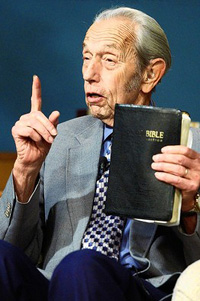
Harold Camping in 2002
That day is Saturday, May 21, says the Oakland, California-based evangelical Christian Family Radio host Harold Camping. By his calculations, May 21, 2011 marks the beginning of end of the world, when Jesus returns to judge us all and rapture those who believe in Him. How did Camping arrive at this date? Genesis 7:4 states that, “Seven days from now I will send rain on the earth for forty days and forty nights, and I will wipe from the face of the earth every living creature I have made.” Seven days is actually 7,000 years because in 2 Peter 3:8 it notes that a day is as a thousand years. (Although apparently 40 days is not 40,000 years of rain.) The Noachian flood unleashed its rain of terror in 4990 B.C., so if you add 7,000 years minus 1 (because there was no year zero), you arrive at 2011. Camping claims that May 21 is the 17th day of the 2nd month of the Hebrew calendar, from which the biblical chronology of the flood is determined. Therefore, May 21 is the Big Day. Continue reading…
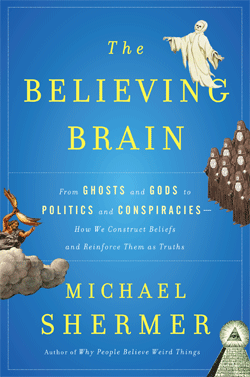
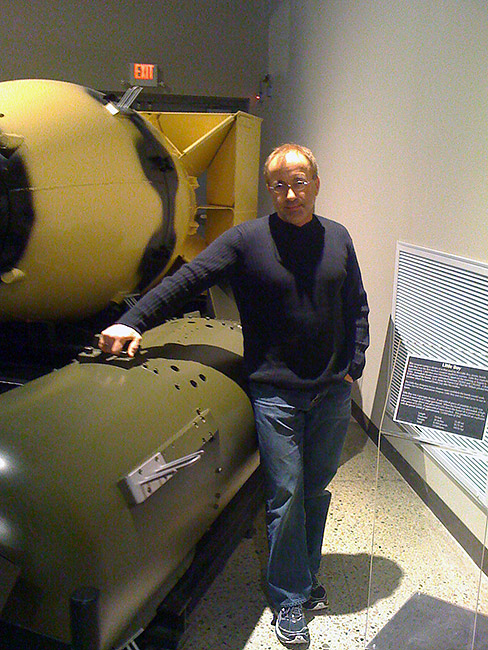
On Saturday, February 5, 2011, my audio book producer John Wagner and I took a break from endless hours of my reading aloud (with John editing out my countless mistakes) my next book, The Believing Brain, which ironically includes chapters on UFOs, aliens, and conspiracy theories. Ironic because for this break John and I took what we thought would be an uneventful tour of the beautiful new National Museum of Nuclear Science and History in Albuquerque, New Mexico.
This is definitely a museum well worth visiting for a comprehensive tour of all things atomic. It was originally opened in 1969 as the Sandia Atomic Museum, but then changed in 1973 to the National Atomic Museum to include a broader history of the peaceful use of nuclear energy, and finally morphed into the new building that now houses the collection, which includes replicas of the Fat Man and Little Boy bombs (see photograph), along with a B-29, a B-52, an F-105, an A-7, an Atomic Cannon, a Titan II Rocket, a Minuteman Missile, a Jupiter Missile, a Thor Missile, and hundreds more smaller items inside the museum building itself, including these two amusing early uses of atomic energy for “health” purposes: Continue reading…
As a skeptic and atheist I am often asked, “What do you believe in?” The ending preposition implies something more than what factual claims are to be believed, such as evolution, quantum physics, or the big bang. What is suggested by the question is what values does one believe in or hold to, especially without belief in God and religion. Here is my answer.
I believe in the Principle of Freedom: All people are free to think, believe, and act as they choose, so long as they do not infringe on the equal freedom of others.
I believe in civil liberties, civil rights, and the freedoms guaranteed in the United States Constitution, including and especially freedom of speech, freedom of association, freedom to assemble peacefully, freedom to petition grievances, freedom to worship (or not), freedom of the press, freedom of reproductive choice, freedom to bear arms, etc. Continue reading…
Last week I blogged about lying: “Everyone Lies: Why?”
Deception is one thing, self deception is quite another. This week TED.com has posted my new TED talk, delivered at the last TED conference, in which I present material from my forthcoming book on the neuroscience of belief, tentatively entitled The Believing Brain, a central theme of which is how we are so easily deceived and how we deceive ourselves. Here is a brief summary of the thesis of the talk, although because it is so visual I strongly recommend watching the TED video.
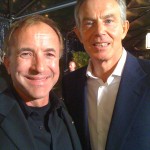
Last week I attended the Khosla Ventures summit at Cavello Point in Sausalito, California, an ex-army base converted to a posh resort, where the venture capitalist (he calls himself a “venture assistant”) Vinod Khosla brings together start-up CEOs and their venture backers who are together innovating new science and technologies for alternative and environmentally efficient energy sources. Vinod heard my TED talk in Long Beach in February 2010 (to be posted at TED.com in June) and invited me to explain why people believe weird things about money (“The Mind of the Market”, based on my book of the same title). Vinod hosted a fireside chat with Bill Gates and Tony Blair, and in the Q & A I raised my hand and asked Tony a question. By way of background… Continue reading…
On April 10 the Wall Street Journal published a debate between myself and Gregory Paul on the question of whether or not belief in God is innate. Here are the links to the two articles:
The online version was well edited but shorter than my original draft, which I present here just for the record. Enjoy.
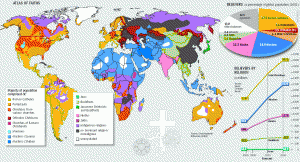
According to Oxford University Press’s World Christian Encyclopedia, 84 percent of the world’s population belongs to some form of organized religion, which at the end of 2009 equals 5.7 billion people who belong to about 10,000 distinct religions, each one of which may be further subdivided and classified. Christians, for example, may be aportioned among 33,820 different denominations.1 Among the many bionomial designations granted our species (Homo sapiens, Homo ludens, Homo economicus), a strong case could be made for Homo religiosus. And Americans are among the most religious members of the species. In a 2007 Pew Forum survey of over 35,000 Americans, the following percentages of belief were found: Continue reading…