by
Michael Shermer, Nov 06 2012
Why there cannot be a deity beyond the natural world
that science can discover
On Saturday, November 3, 2012 I spoke at the big atheists’ conference in Mexico City on The Believing Brain, my latest book in which I develop a theory to explain not just why people believe weird things, but why people believe anything at all, including and especially god beliefs. (I don’t know if the talk will be posted Online but it is an expanded version of my TED talk or this longer version.
In the audience was the biologist Jerry Coyne, the author of one of the best defenses of evolutionary theory ever penned: Why Evolution is True. He posted a blog about my lecture in which, surprisingly (given his staunch militancy for atheism), he expressed a difference with me in the possibility of there being a God. He writes:
While I respect Shermer’s view that invoking aliens or some unknown explanation avoids a “god of the gaps” argument for unknown and miraculous or divine phenomena, I still feel as a scientist that the existence of a true supernatural god is a theoretical possibility, and that there is some possible evidence that could convince me of it. (I’ve described that evidence before; needless to say, none has been found.) Yes, such miraculous evidence for a god might eventually be found to be due to aliens or the like, but my acceptance of a god would always be a provisional one, subject to revision upon further evidence. (We might find aliens behind the whole thing.) After all, every scientific “truth” is provisional.
Jerry’s allusion to alien gods is in reference to my brief summary in the Q&A of what I originally proposed in a 2002 Scientific American column entitled “Shermer’s Last Law” (title written with tongue firmly in cheek because naming laws after oneself is a sure sign of crankdom Continue reading…
comments (19)
by
Michael Shermer, May 31 2011
The following excerpt is from the Prologue to my new book, The Believing Brain: From Ghosts, Gods, and Aliens to Conspiracies, Economics, and Politics—How the Brain Constructs Beliefs and Reinforces Them as Truths. The Prologue is entitled “I Want to Believe.” The book synthesizes 30 years of research to answer the questions of how and why we believe what we do in all aspects of our lives, from our suspicions and superstitions to our politics, economics, and social beliefs. LEARN MORE about the book.
According to a 2009 Harris Poll of 2,303 adult Americans, when people are asked to “Please indicate for each one if you believe in it, or not,” the following results were revealing:1
-
82% believe in God
-
76% believe in miracles
-
75% believe in Heaven
-
73% believe in Jesus is God
or the Son of God
-
72% believe in angels
-
71% believe in survival
of the soul after death
-
70% believe in the
resurrection of Jesus Christ
-
61% believe in hell
-
61% believe in
the virgin birth (of Jesus)
-
60% believe in the devil
-
45% believe in Darwin’s
Theory of Evolution
-
42% believe in ghosts
-
40% believe in creationism
-
32% believe in UFOs
-
26% believe in astrology
-
23% believe in witches
-
20% believe in reincarnation
Wow. More people believe in angels and the devil than believe in the theory of evolution. That’s disturbing. And yet, such results should not surprise us as they match similar survey findings for belief in the paranormal conducted over the past several decades.2 And it is not just Americans. The percentages of Canadians and Britons who hold such beliefs are nearly identical to those of Americans.3 For example, a 2006 Readers Digest survey of 1,006 adult Britons reported that 43 percent said that they can read other people’s thoughts or have their thoughts read, more than half said that they have had a dream or premonition of an event that then occurred, more than two-thirds said they could feel when someone was looking at them, 26 percent said they had sensed when a loved-one was ill or in trouble, and 62 percent said that they could tell who was calling before they picked up the phone. In addition, a fifth said they had seen a ghost and nearly a third said they believe that Near-Death Experiences are evidence for an afterlife.4
Continue reading…
comments (42)
by
Michael Shermer, Sep 21 2010
The “Quantum Flapdoodle” of Deepak Chopra and his notion of the deity as a nonlocal quantum mind
Do you believe in God? In most surveys, about nine out of ten Americans respond in the affirmative. The other ten percent provide a variety of answers, including a favorite among skeptics and atheists, “which God?,” spoken in a smarmy manner and followed by a litany of deities: Aphrodite, Amon Ra, Apollo, Baal, Brahma, Ganesha, Isis, Mithras, Osiris, Shiva, Thor, Vishnu, Wotan, and Zeus. “We’re all atheists of these gods,” goes the denouement, “some of us go one god further.”
I have debated many a theologian who make the traditional arguments for God’s existence: the cosmological argument (prime mover, first cause), the teleological argument (the universe’s order and design), the ontological argument (if it is logically possible for God to exist then God exists), the anthropic argument (the fine-tuned characteristics of nature), the moral argument (awareness of right and wrong), and others. These are all reasons to believe if you already believe; if you do not already believe these reasons ring hollow and have been refuted by philosophers from David Hume to Daniel Dennett.
This last spring, however, I participated in a debate with a theologian of a different species—the New Age spiritualist Deepak Chopra—whose arguments for the existence of a deity take a radically different tact. Filmed by ABC’s Nightline and viewed by millions, Deepak hammered out a series of scientistic-sounding arguments for the existence of a nonlocal spooky-action-at-a-distance quantum force. Call it Deepak’s God 2.0. Continue reading…
comments (78)
by
Michael Shermer, Apr 20 2010
On April 10 the Wall Street Journal published a debate between myself and Gregory Paul on the question of whether or not belief in God is innate. Here are the links to the two articles:
http://tinyurl.com/y8n7qg6
http://tinyurl.com/y52ckwf
The online version was well edited but shorter than my original draft, which I present here just for the record. Enjoy.
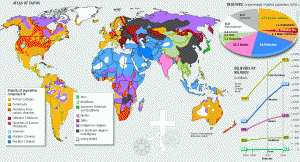
According to Oxford University Press’s World Christian Encyclopedia, 84 percent of the world’s population belongs to some form of organized religion, which at the end of 2009 equals 5.7 billion people who belong to about 10,000 distinct religions, each one of which may be further subdivided and classified. Christians, for example, may be aportioned among 33,820 different denominations.1 Among the many bionomial designations granted our species (Homo sapiens, Homo ludens, Homo economicus), a strong case could be made for Homo religiosus. And Americans are among the most religious members of the species. In a 2007 Pew Forum survey of over 35,000 Americans, the following percentages of belief were found: Continue reading…
comments (76)
by
Michael Shermer, Jan 12 2010
Nothing fuels religious extremism more than the belief that one has found the absolute moral truth. Islamic terrorism, for example, has gradually shifted from secular motives in the 1960s to religious motives today. A 2000 study by the state department that resulted in the publication Patterns of Global Terrorism, found that in 1980 there were only two out of sixty-four militant Islamic groups whose mission was religiously based. In 1995 that figure had climbed to nearly half. The figure is undoubtedly higher today. (http://fpc.state.gov/documents/organization/54249.pdf)
It is a type of fuel that can lead to what Clay Farris Naff, Executive Director of the Center for the Advancement of Rational Solutions in Lincoln, Nebraska, cleverly calls the “neuron bomb,” after its cold-war counterpart, the “neutron bomb,” designed to kill people while leaving buildings and infrastructure in tack. A schematic of the neuron bomb looks like this: Continue reading…
comments (52)
by
Michael Shermer, Sep 08 2009
I believe in the power of science and humanity. Specifically, I believe that biodiversity is a good thing and that we have been rapacious in our treatment of the environment, although I think the environmental movement has greatly exaggerated our condition and that the environment is a lot more resilient than most environmentalists give it credit for. I don’t mind eating cows and fish, but dolphins and whales have big brains and they’re cool, so I don’t think we should kill them. I drive an SUV because I haul around bicycles, books, and dogs, but as soon as there is a bigger hybrid, I’ll buy it. And although I am a libertarian heterosexual who is about as unpink (in both meanings) as you can get, I believe people should have an equal opportunity to be unequal. As for evolution, it happened. Deal with it. Continue reading…
comments (128)
by
Michael Shermer, Aug 18 2009
Did humans evolve to be religious and believe in God? In the most general sense, yes we did. Here’s what happened.
Long long ago, in an environment far far away from the modern world, humans evolved to find meaningful causal patterns in nature to make sense of the world, and infuse many of those patterns with intentional agency, some of which became animistic spirits and powerful gods. And as a social primate species we also evolved social organizations designed to promote group cohesiveness and enforce moral rules.
People believe in God because we are pattern-seeking primates. We connect A to B to C, and often A really is connected to B, and B really is connected to C. This is called association learning. But we do not have a false-pattern-detection device in our brains to help us discriminate between true and false patterns, and so we make errors in our thinking Continue reading…
comments (138)
by
Michael Shermer, Aug 11 2009
Cartoonist Sidney Harris once illustrated two scientists at a chalkboard. One has written, among mathematical equations, “Then a miracle occurs,” to which his colleague replies, “I think you need to be more specific here in step two.” This nicely sums up the relationship between science and religion: one deals in the natural while the other deals in the supernatural. And never the twain shall meet.
Were only it were so. Unfortunately, religions routinely make claims about the natural world that are in direct conflict with the scientific evidence. Young-Earth Creationists, for example, believe that the world was created around 6,000 years ago, about the same time that the Babylonians invented beer. These claims cannot both be correct, and anyone who thinks the former is right has relegated all of science (along with brains) to the dumpster of life. Many people of faith believe that prayer can cajole the deity into taking action in our world to do everything from healing cancers to winning wars. Yet a comprehensive controlled scientific study on the efficacy of prayer on healing, funded by the religiously-based Templeton Foundation and conducted at the prestigious Harvard Medical School, found no relationship between the two: subjects in the non-prayed for group did just as well (or poor) as those in the prayed for group. And why is it, scientists want to know, that prayer only seems effective for things that might have happened anyway, such as tumors going into remission. A more dramatic and unmistakably religious miracle that would shock even the most skeptical of scientists would be if prayers for amputees (especially our brave wounded Christian soldiers returning from Iraq and Afghanistan) resulted in renewed whole limbs; i.e., a true miracle. Continue reading…
comments (154)
by
Ryan Johnson, Dec 23 2008
It’s a very weird time of year for the non-religious skeptic. Everyone is going to church, talk of Jesus and God abound and the holiday discussion is centered around whether we should say Happy Holidays or Merry Christmas.
I didn’t grow up in a very religious home. My parents allowed me to make my own decision about religion. I went to bible school a few times when I was a child during summer. I even attended a Christian private school from pre-school to 1st grade. My only recollection of that experience is that the staff was scary and that I had to memorize verses every week. How that relates to a good education, I still have no idea. My parents, thankfully, figured this out quickly and put me into public school, where I really learned a lot and could grow up to be a well-rounded, healthy person.
Religion is such a sensitive subject, I even thought twice about whether I wanted to write anything on the net that talks about religion, and my views of it. I know there are friends that I have that are very religious, that may read this. Generally, I just avoid that subject with them, because most of the time, I have no desire to discuss or quarrel with them on my religious views. My friendship is more important that one aspect of their lives not aligning with mine.
Continue reading…
comments (22)