by
Donald Prothero, Apr 22 2014
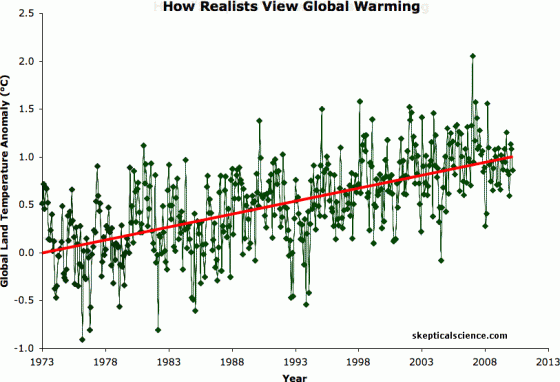
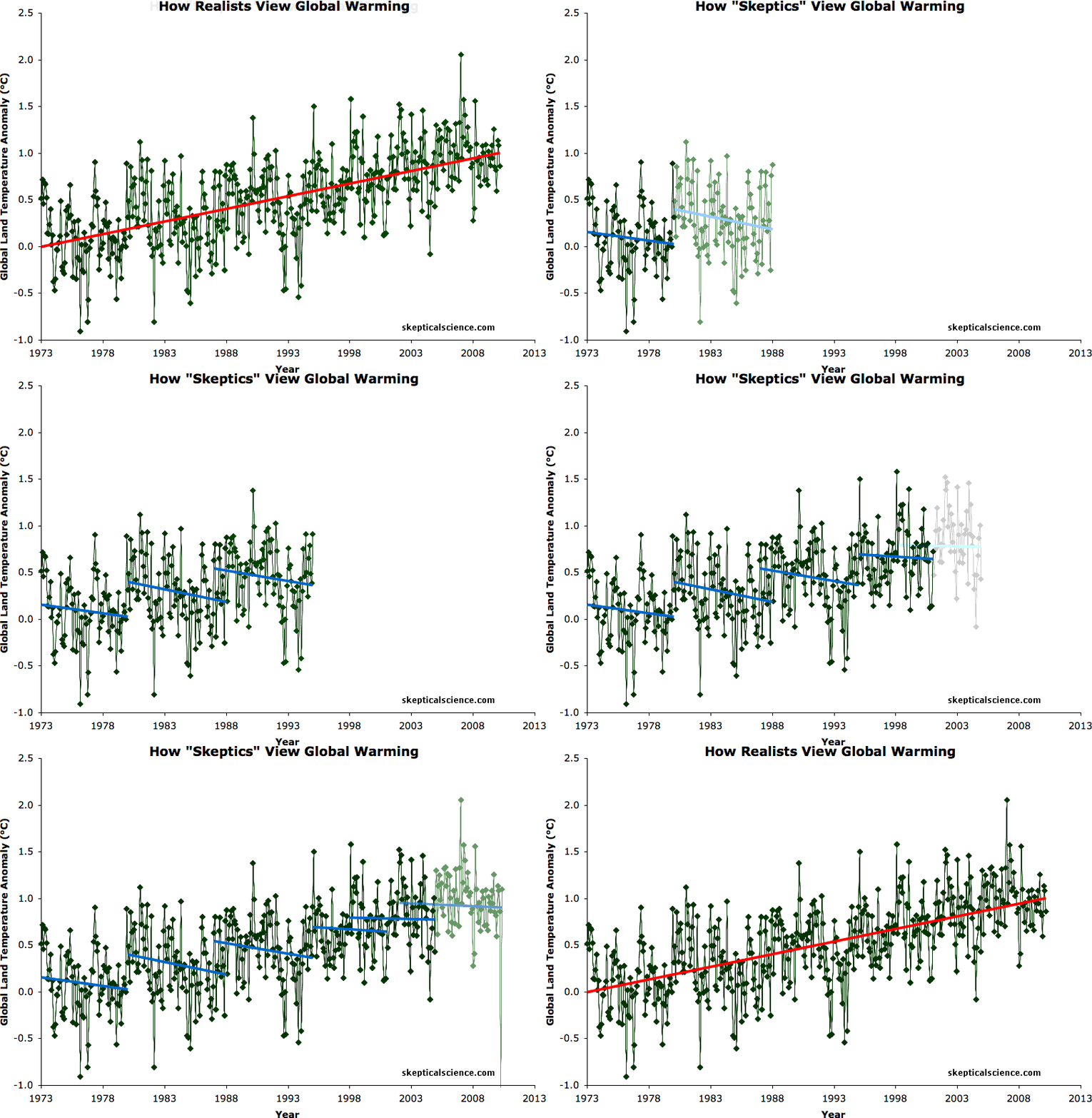
Any data set can be falsely manipulated to distort its meaning. For example, if you just plot short segments of the noisy climate data set, you could imagine a series of short-term “cooling” trends (click on the image). But statistically the only valid approach is to average over the long term, when there is undeniable warming taking place
In the spirit of Earth Day, which happens today, I’ll blog about another important ecological topic: the alleged “global warming pause”.
About a year ago, I wrote a post about the climate-denier myth that “it’s been cooling since 1998″. As the post pointed out, this is based on cherry-picking the anomalously warm year of 1998 (atypical because it was an extraordinary El Niño year that brought a lot of heat from the tropical oceans into the atmosphere), then deliberately picking one or two years following and calling that “cooling”.
As the climate deniers have been called out about this lie, they’ve shifted the goalposts, and made the claim that the global warming has “paused” since 1998. As reported in Mother Jones, Fox News began playing this meme over and over again in 2012, so that soon the regular media were echoing their meme as well. But is it true? NO! Continue reading…
comments (59)
by
Donald Prothero, Oct 16 2013

A review of The Hockey Stick and the Climate Wars: Dispatches from the Front Lines
by Michael E. Mann
(Columbia University Press, New York, 395 pp., 2012)
The topic of global climate change has become one of the hottest global issues for over a decade now, figuring prominently in U.S. politics, and leading to many international conferences on how to contain it. As a scientific debate, the facts were resolved over a decade ago. Survey after survey over the past decade have shown that roughly 95-99% of scientists who publish peer-reviewed research in climate change agree that global climate is changing rapidly and that humans are to blame. This is a level of consensus in science similar to that supporting gravity, plate tectonics, big bang cosmology, quantum physics—or evolution. Yet for reasons having nothing to do with science (i.e., religion or ideology), there are powerful vested interests in the United States that don’t like the “inconvenient truths” of evolution or big bang cosmology (creationists) or climate change (libertarians and free-market conservatives, backed by the fossil fuel industry). They are determined to fight scientific consensus by any means necessary. In contrast to Canada, or any major industrialized nation in Europe or in eastern Asia (including Japan, South Korea, China, and others), the U.S. is the only nation where science deniers (creationists and climate deniers) comprise any significant part of the population, and have a lot of influence in a major political party, so they can prevent any political action on the issue. Continue reading…
comments (34)
by
Donald Prothero, Apr 17 2013
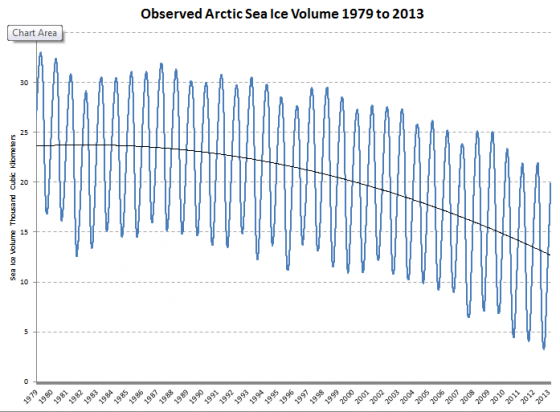
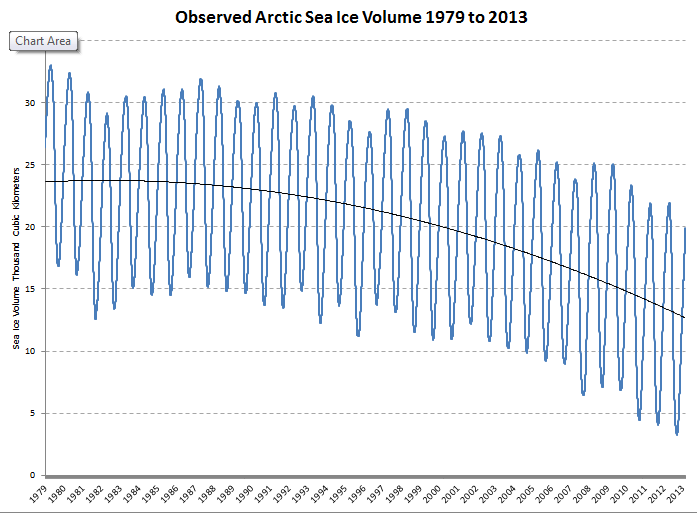
The rapid disappearance of the Arctic sea ice, with an averaged curve (black line) fitted to the annual cyclic variation of seasonal ice (fluctuating blue curve).
The year 2012 and now early 2013 have been an unending litany of bad climate news. After a record-breaking year of heat and drought in North America, and with devastating Superstorm Sandy, and record heat and fires in Australia, the year 2012 ended up being the ninth hottest year on record despite a strong La Niña cycle that should have made it a lot cooler. Once the current La Niña cycle ends, you can expect the next few years to blast past the previous global temperature record of 2010. As it is, nine of the ten hottest years on record were in the last decade—only the record-breaking El Niño year of 1998 didn’t occur in the window between 2002 and 2012.
Even more alarming were the weekly reports about the incredibly fast loss of our global ice volume, from mountain glaciers to the Greenland and Antarctic continental ice sheets. Most serious of all, however, is the record melting of the Arctic ice. Last summer, the Arctic ice cap shrank to the lowest level ever measured, and even the winter ice pack was the fifth smallest ever measured. And the news just came in that the melting rate of the Antarctic ice cap is the highest ever recorded. If anything will cause the rapid rise of sea level, it will be the melting of these ice sheets. Then we’ll see not only low-lying countries disappear, but more storms like Superstorm Sandy, whose storm surge will reach much further inland with a higher sea level base. Continue reading…
comments (133)
by
Donald Prothero, Feb 20 2013
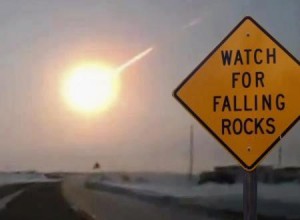
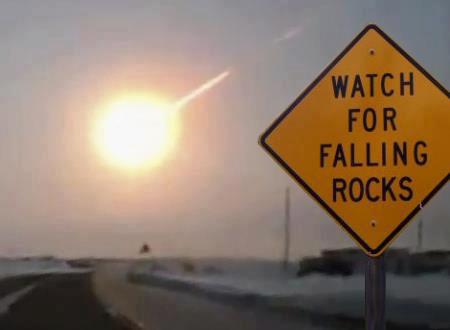
Last Friday we all got a message from space. For weeks, scientists had been talking about the close pass of Asteroid 2012 DA14, and trying to use it as an opportunity to educate the public about the risk they might pose. Then, without any warning, a much smaller piece of rock zipped through the sky above Siberia and left lots of damaged windows and buildings—and a LOT of amazing footage from cameras of every kind (including lots of dash cams, which are the rage in Russia because of all the horrendously scary driving and insurance issues). Immediately, the media and internet was flooded with stories of every kind, from the merely uneducated (typically from mainstream media newspeople who know no science) to the positively weird. Count on an event like this, which grabbed the media’s fleeting attention worldwide for a precious day, to be the source of every bizarre notion you can imagine (and some you can’t).
First, some basics. It was apparent as news people all over the media mangled the terminology that most people don’t know one space object from another. Yet all of these objects in space have distinct names, and it’s not OK to interchange one with another. Thanks to the many crappy sci-fi movies about impacts threatening civilization and requiring Bruce Willis to save President Morgan Freeman and the rest of the world (never mind that none of them are remotely plausible scientifically), some of this misunderstanding is excusable. These mistakes are just symptomatic of the general scientific illiteracy of most people—sadly, even among news media people who should understand more of the facts behind the news they read than they actually do. (Cue the references to the hyper-smart newsman played by Jeff Daniels in the HBO series “The Newsroom”, who actually knows the facts behind most stories, and can conduct in-depth interviews without cue cards or teleprompters). Just so we’re all clear on these things, a helpful graphic is provided below the fold.
Continue reading…
comments (31)
by
Brian Dunning, Jan 03 2013
 Anyone who has ever pointed out that a scientific consensus exists on a certain matter has probably been meet with laughter and derision. The word consensus has practically become a punchline. It is reminiscent of the famous corollary to Godwin’s Law which states that the first person to mention Nazis has automatically lost the argument; so it frequently goes with the first person to mention consensus. So many highly visible personalities deny and deride scientific consensus that the term has, in popular usage, become synonymous with a fatally weak argument. Continue reading…
comments (44)
by
Donald Prothero, Dec 19 2012

These tiny planktonic snails known as pteropods, or “sea butterflies”, are critically sensitive to small changes in ocean acidity, and are now vanishing as the oceans dissolve their thin shells. Without their huge numbers in the plankton, many animals higher up the food chain will die, too.
As we approach the phony hysteria over the end of the world this coming Friday, it’s worthwhile to consider some real threats to the planet. Climate deniers try to distort or obfuscate the evidence about the changing atmosphere, and it’s not always easy to give overwhelmingly conclusive data that would convince them. In some cases the data are tricky to analyze, or do not have well-documented long-term histories necessary to answer every concern about whether recent weather events are truly unprecedented. The atmospheric system is very complicated, with many different processes operating on short-term, medium-term, and long-term time scales, and not all of it is as well understood as we would like. Thus, the arguments over changes in earth’s atmosphere often reach an impasse.
Not so for the oceans. Although oceans are an even larger system than the atmosphere, we understand them much better. More importantly, we have an excellent long-term record of how the oceans have changed over millions of years from thousands of deep-sea cores, and from the paleontological record of marine fossils that goes back over 700 million years. And unlike the atmospheres, oceans change very slowly over time, since the thermal inertia of water makes the seas very resistant to change except on long-term time scales. In addition, most ocean currents move slowly compared to atmospheric currents. So no matter what you want to make of the data showing atmospheric change, the changes in the oceans are more alarming, since oceans require immense stimuli to cause such change. Continue reading…
comments (31)
by
Donald Prothero, Nov 14 2012
The “end of the world” allegedly predicted by the Mayan calendar in December 2012 may be a myth, but 2012 had no shortage of catastrophes. We had the warmest year in history in North America, with record-breaking heat waves through much of the summer, and drought conditions approaching those of the Dust Bowl years. A July heat wave melted 97% of the surface of the Greenland ice sheet, the worst melting since satellite monitoring began 30 years ago. Arctic sea ice cover in September was at an the all-time low, beating the record set only back in 2007. 2011 was not much better, with Hurricane Irene flooding the Northeast, a large number of killer tornadoes (including deadly storms in Missouri and Alabama), 500-year floods in Nashville and Duluth, and severe wildfires all over the parched Rocky Mountains. It seems that the news is full of one unprecedented weather event after another, and those jokes about snowy winters a few years ago seem lame when most of the U.S. population sweltered through the heat waves of 2012. Continue reading…
comments (57)
by
Donald Prothero, May 16 2012
As I discussed in a previous post (April 11), the people who deny anthropogenic global warming (AGW) have many similarities to creationists. Despite the fact that the reality of AGW is supported by a 95% or greater consensus of qualified climate scientists, the critics (mostly non-scientists, or scientists in fields that do not qualify them to assess climate science) keep on repeating the same false tropes over and over again, no matter how many times they are debunked. This is analogous to the shopworn old arguments of creationists, who invariably trot out fallacious arguments like “evolution contradicts the Second Law of Thermodynamics” even though it has been corrected hundreds of times by scientists. The creationists have such a strong denial filter to resolve their cognitive dissonance that they either don’t realize why their “Second Law” argument is invalid, or they are deliberately and deceptively using it over and over again because it impresses their scientifically illiterate following.
The same is true of the long-debunked example of cherry picking, “It hasn’t warmed since 1998″ (see my April 11 post). Another common false statement is “The planet warmed just as much during the Medieval Warm Period, but eventually it cooled down again.” They argue that if this warming preceded our modern injection of carbon dioxide into the atmosphere, then maybe our current global warming not caused by our burning of fossil fuels. Climate deniers repeat this old saw over and over again as if it’s somehow a devastating blow to the huge body of data about our recent climate changes. They often illustrate it with the anecdotes about how the Vikings could colonize Greenland for a while, then as climate cooled in the late Middle Ages, these colonies failed when Greenland became too cold again. The story about the fate of Viking colonies in Greenland is true—but the rest is not.
Continue reading…
comments (52)
by
Donald Prothero, Apr 11 2012
One of the most familiar memes we hear from the climate-change deniers is the phrase, “Global warming ended in 1998 and it’s been cooling since then.” You find something along these lines on most of the AGW denier books and websites, and it is repeated endlessly as if somehow repetition makes it more true. This is just like creationists who continually repeat the phony argument that “evolution violates the Second Law of Thermodynamics”, even though this is patently false. As has been pointed out many times, the Second Law only applies to closed systems. The earth is not a closed system since it receives energy from the sun. Yet in every creationist book and website and debate for many decades now you’ll hear them repeat it over and over again, since it sounds impressive to their scientifically unsophisticated audience and apparently they cannot understand why it’s wrong, or they don’t care as long as it suits their political agenda.
One of the most famous examples of the “cooling since 1998″ meme occurred when conservative pundit George Will wrote in a Feb. 15, 2009 Washington Post column, “Dark Green Doomsayers,” that “According to the World Meteorological Organization,there has been no record of global warming for more than a decade.” The same column also printed false claims about the retreat of the glaciers, and about scientists predicting global cooling back in the 1970s (all discussed and debunked in Jim Powell’s new book The Inquisition of Climate Science, pp. 75-79). Will was taken to task by climate scientists all around the world for his mistakes and misrepresentations, but he never retracted them. The Washington Post ombudsman tried to justify running Will’s column and rationalize their lax fact-checking procedure, writing that “opinion columnists are free to choose whatever facts bolster their arguments. But they are not free to distort them.” Eventually, the uproar was so great at Will’s egregious distortions that the Post printed two separate columns rebutting him. Apparently learning nothing from the experience, Will dug an even deeper hole by again claiming in an April 2, 2009, column that there hasn’t been a warmer year since 1998.
Continue reading…
comments (231)
by
Donald Prothero, Mar 21 2012
The recent passing of Sherwood Rowland, who won the 1995 Nobel Prize in Chemistry for his discovery (along with Mario Molina and Paul Crutzen) that CFCs (chlorofluorocarbons) break down ozone in the stratosphere, causes me to think back on that furious debate over environmental issues—and the remarkable way it was resolved by international agreement and no longer threatens us. Those of us who are old enough to remember the political events of the 1970s and 1980s might recall the big public concern over the ozone layer. Like the debate over acid rain, this environmental crisis arose from earlier research that suggested a problem, then ran into huge opposition from conservative business and anti-environmental interests during the 1980s when Reagan’s cronies were in power. Like the debate over acid rain, the evidence for the hole in the ozone layer only increased until the pressure from scientists and governments around the world overcame the resistance of the affected industries, and resulted in an eventual global agreement to curb the causes of this pollution.
The story began in the late 1960s when the U.S. and Europe were both engaged in a race to develop a supersonic transport (SST) for civilian passengers, which would whisk people around huge distances in much shorter times (primarily between Europe and America). I vividly remember this series of events, because my father worked for Lockheed Aircraft at the time, and spent years of his life working very long hours to develop a huge multivolume “proposal” for how the Lockheed SST would be built. Huge numbers of man-hours and millions of dollars building two working prototype aircraft were wasted by Lockheed in the competition when the contract went to Boeing Aircraft instead. Ironically, the Boeing SST was eventually canceled, too. The only SST that was built was the Anglo-French Concorde, which traveled between New York and Paris from 1976 until it was retired in 2003 due to low demand after the 2000 Concorde crash, low air traffic after 9/11, and high costs since most of the electronics in the aircraft were over 30 years old and obsolete. Continue reading…
comments (32)