SkepticBlog is a collaboration among some of the most recognized names in promoting science, critical thinking, and skepticism. Regular bloggers include: Brian Dunning, Daniel Loxton, Donald Prothero, Mark Edward, Michael Shermer, and Steven Novella. This site is hosted by the Skeptics Society.
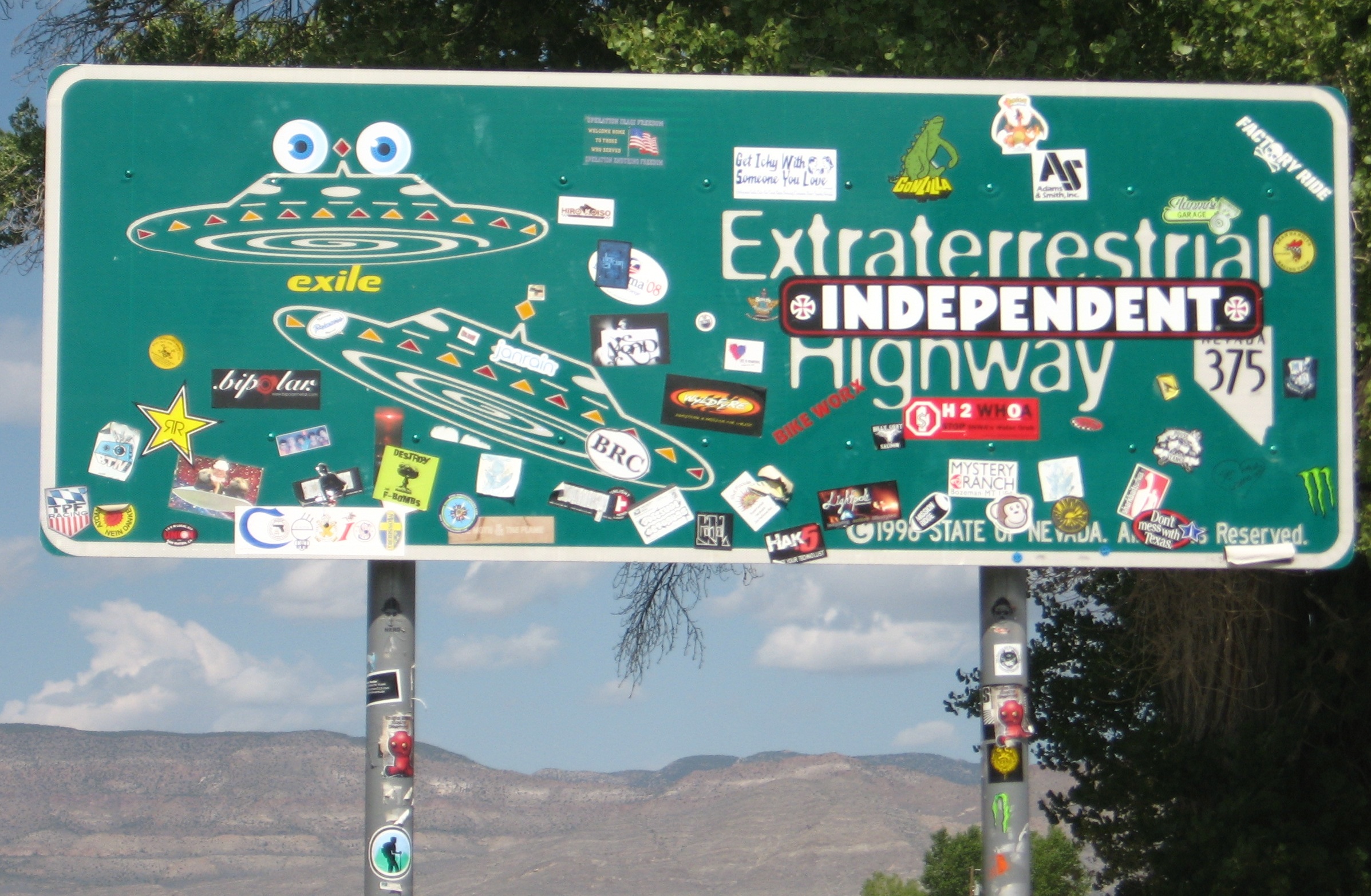
Come join the Skeptic Society for our trip to Area 51 and other alien landscapes, Martin Luther King weekend (January 18-20), 2014. We will spend 3 days exploring the “Extraterrestrial Highway” (with lunch at the Little A’Le’inn), collecting trilobites, and visiting the National Atomic Testing Museum and their UFO exhibit, as well as the alien landscape of Valley of Fire State Park and Calico Ghost Town. Both nights will be spent at the MGM Grand Hotel in Las Vegas. For further details, see this link. Hurry! We’re down to our last few seats!
We are driving west in a black GMC Yukon Denali SUV across the “Extraterrestrial Highway” (Nevada State Highway 375), about three hours north from Las Vegas. The road itself is unremarkable—miles and miles of a ribbon of asphalt cutting across barren desert of mesquite and Joshua tree yuccas, with no signs of life anywhere. Occasionally the road rises up from the low flats to cross a small mountain range, with jagged rocks exposed on all sides, completely devoid of vegetation. During the summer, the temperatures here stay above 100°F for weeks on end, and almost no one comes through here. In the winter, the daytime temperatures are more comfortable, but at night it gets bitterly cold, especially if the desert winds are howling through the area. It’s also over 4400 feet in elevation here, so some winters are cold enough that snow will accumulate on the high desert surface, and may persist on the peaks well into the spring.
After you pass through the tiny towns of Alamo and Ash Springs (last gas station for 150 miles or more) on U.S. Highway 93, and turn west on to Highway 375, you drive about 15 miles until you reach Hancock Summit, a mountain pass over barren rock that is the highest place in the region. You can get out of your car and look to the southwest, but all you will see is the Groom Range to your west. The military base is down in the valley beyond, and there is no other spot in any direction where you could see the base from the paved road. You can make the strenuous hike to Tikaboo Peak to the south, and see parts of the base on the other side of the range without incurring the wrath of base security, but this isn’t much more informative. Continue reading…
Last week I commented on conventions of pseudoscientists, from the creationists to Flat Earthers and neo-geocentrists, and, most recently, the contemporary “natural philosophers” who deny most of modern physics, from Einsteinian relativity to quantum mechanics to the rejection of ether. As that post was running, just an hour drive from my home there was a meeting of the “Mutual UFO Network” (MUFON), which held their annual convention at a the Hyatt Regency Hotel in Irvine, California. The theme of the meeting was “ET Contact: Implications for Science and Society”, and the program featured a keynote address by astronaut Story Musgrave. Ironically, Musgrave believes in intelligent aliens, but he is convinced that they have never visited the earth—a big disappointment for most of the crowd. There was a full Saturday program that included talks like, “Will ET Contact Put an End to our World’s Religions?” “Secrets of Antigravity Propulsion” and “Time Travel is a Fact”, along with the expected presentations on government cover-ups of UFO evidence, and how these people expect contact with aliens will change science and society. One or two presenters had Ph.D. or M.A. degrees (which they flaunted conspicuously, even though there is no information as to whether their Ph.D. has any relevance to the field), but the rest are pure amateurs. There was even a talk on “Mars, the Living Planet”, apparently ignoring all the recent evidence that Mars is now completely frozen, and that if it has (or had) life, it was only tiny microbes.
Just last week, a strange phenomenon occurred which casts light on the mindset of people inclined to believe in the paranormal. Among the Top 10 best-selling books this week is Area 51: An Uncensored History of America’s Top-Secret Military Base by “journalist” Annie Jacobsen. In the genre of crazy books about aliens and UFOs, this one is the nadir. Not only does it recycle all the debunked garbage about Area 51 and the Roswell “alien crash,” but it strains the limits of credulity by claiming the Roswell crash wasn’t an alien craft, nor the weather balloon that the evidence has really shown was behind the myth. No, the Roswell crash was actually a Nazi-inspired Soviet aircraft sent by Stalin to make us think we were being invaded by aliens, and the “aliens” are malformed teenagers resulting from genetic experiments of Nazi doctor Josef Mengele. At last, a crazy paranormal story complete with UFOs, Area 51, Roswell, conspiracy, Communists, and Nazis, all rolled up into one!
Her evidence for this bizarre story? It came allegedly a “retired unnamed engineer” from the government contractor EG&G (now part of URS Corporation). No one asked the obvious question about what a retired aerospace engineer would be doing examining bodies, or how he would know they were genetically and surgically altered. In fact, we didn’t even know the structure of DNA until 1953, so there is no way someone could do “genetic engineering” in the 1940s. And if the “teenagers” were genetically engineered by the Soviets using Mengele, they would have to have grown up remarkably fast in the two years from 1945 when Soviets occupied Berlin until 1947, when the Roswell incident took place. In addition, this supposedly all took place over 64 years ago, and this alleged “engineer” would have to be at least in his 30s to have the training and experience to hold such a job. If you do the math, he’s in his 90s or older. Doesn’t that strike anyone as suspicious? Doesn’t that fail the “smell test” of credibility for most people? When Jacobsen was questioned skeptically by interviewer Terry Gross of the radio program Fresh Air on NPR about the problems with the “engineer” story, all she could say is “I don’t think he is lying to me.”
On Saturday, February 5, 2011, my audio book producer John Wagner and I took a break from endless hours of my reading aloud (with John editing out my countless mistakes) my next book, The Believing Brain, which ironically includes chapters on UFOs, aliens, and conspiracy theories. Ironic because for this break John and I took what we thought would be an uneventful tour of the beautiful new National Museum of Nuclear Science and History in Albuquerque, New Mexico.
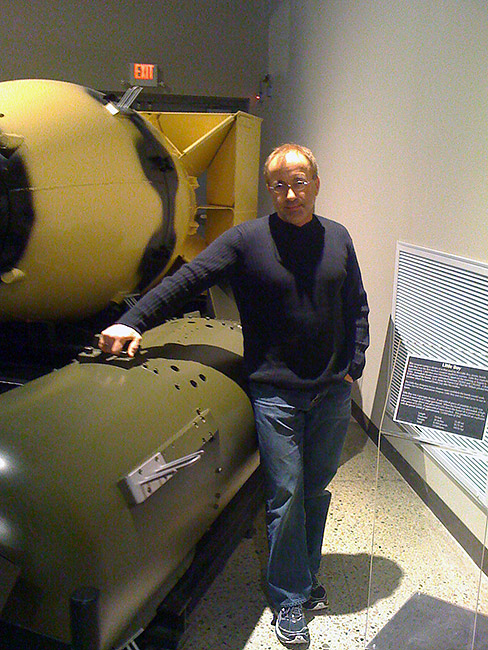
This is definitely a museum well worth visiting for a comprehensive tour of all things atomic. It was originally opened in 1969 as the Sandia Atomic Museum, but then changed in 1973 to the National Atomic Museum to include a broader history of the peaceful use of nuclear energy, and finally morphed into the new building that now houses the collection, which includes replicas of the Fat Man and Little Boy bombs (see photograph), along with a B-29, a B-52, an F-105, an A-7, an Atomic Cannon, a Titan II Rocket, a Minuteman Missile, a Jupiter Missile, a Thor Missile, and hundreds more smaller items inside the museum building itself, including these two amusing early uses of atomic energy for “health” purposes: Continue reading…
Last week I blogged about lying: “Everyone Lies: Why?”
Deception is one thing, self deception is quite another. This week TED.com has posted my new TED talk, delivered at the last TED conference, in which I present material from my forthcoming book on the neuroscience of belief, tentatively entitled The Believing Brain, a central theme of which is how we are so easily deceived and how we deceive ourselves. Here is a brief summary of the thesis of the talk, although because it is so visual I strongly recommend watching the TED video.
As a guest on a recent radio program, I took calls from people who’d had some ghostly experience. It’s not true that such callers are always trying to challenge the evil skeptic: “I saw my grandfather’s ghost at the foot of my bed, explain that, Mr. Skeptic!” In this case, most of the callers (I think) were genuinely hoping for some insight. Although I certainly couldn’t speculate about what their experiences might have been, I was at least able to avoid making some common mistakes that often cost skeptics their credibility.
First, you’re not going to convince a ghost believer by saying “We have no evidence that ghosts exist, nor is there any plausible hypothesis by which they might exist.” No ghost believer in history has ever heard that, said “Aaahh,” smacked themselves in the forehead, turned over a new leaf, and gone forth with a new perspective on reality. Logically, you have just as much evidence that ghosts don’t exist as they have that ghosts do exist. So it’s a weak argument. Thus, no good can come from starting off by contradicting their belief. The only thing it accomplishes is to establish an antagonistic tone. Continue reading…
I’m a big fan of SETI (Search for Extra-Terrestrial Intellience) and I think their search program constitutes the best chance we have of making contact. In fact, on a recent Saturday I was rained out of my normal 4-hour bike ride, so I read SETI scientist Seth Shostak’s new book, Confessions of An Alien Hunter (published by National Geographic), a brilliant and fun read. Seth has a fantastic sense of humor and in his book he presents some of great one-liners to use when dealing with UFOlogists, alien abductees, and the saucerites. For example:
Regarding the time it would take to traverse the vast distances between the stars, which would be millions of years (it will take Voyager II 300,000 years to reach a nearby star), Shostak notes: “That’s a long time to be squirming in a coach seat.”
I was visiting my friend Jim (name changed to protect the embarrassed) when he happened to mention that for a few weeks now, his neighborhood had been receiving regular UFO visits.
At first I wasn’t sure if he was pulling my leg or what. I knew Jim to be a reasonable guy, not given over to the supernatural. Moreover, he was the UFOlogists’ favorite type of witness: A pilot. (Because, as we all know, pilots cannot be mistaken about anything seen in the sky.) But I also knew that Jim could be pretty darn stubborn once an idea got into his head. I realized he was quite serious, and from what he said, a lot of people in the neighborhood were equally serious about it. Well, quite obviously, I had to see it.
So he took me outside into the dark, and what a surreal experience that was. He simply said “Let’s go,” and had the mannerism of every expectation that we’d see the UFO. Like it’s always right there for the taking. Continue reading…
The March 10 episode of my Skeptoid podcast dealt with a number of strange skulls from around the world. One that’s perhaps best known among the strange skull aficionado crowd – if there is such a crowd – is the “Starchild”. It’s the partial skull of a hydrocephalic child who died in Mexico about 900 years ago. At least, that’s what it is according to nearly every knowledgeable person who has seen it. But according to Lloyd Pye, it’s an alien hybrid. Continue reading…
It has finally happened. After decades of skeptics proclaiming that they would drop their skepticism about UFOs and alien abductions if only an extraterrestrial intelligence would contact them directly, it has finally happened right smack in the middle of the Skeptics Society off Hamstring Treatment Manual ices. An ET appeared one day to lay to rest once and for all whether or not ETs have visited earth. And the aliens have a message and a warning about what we earthlings are doing to our planet: Continue reading…


 The
The