by
Michael Shermer, Mar 15 2011
What does the democratic uprising in Egypt and other Arab nations have to do with IBM’s Jeopardy champion Watson in determining the fate of civilization? Think bottom up, not top down; think exponential growth, not linear change; think crowd sourcing, not elite commanding; and think open access and transparency, not closed entree and secrecy. Under the influence of these four forces, such seemingly unconnected events are, in fact, connected at a deeper level when we pull back and examine the overall trajectory of the history of civilization. Continue reading…
comments (58)
by
Michael Shermer, May 18 2010
Liberty and The Man Who Shot Liberty Valance.
This is the third essay in a series on the relationship between rules, freedom, and prosperity.
Read part 1 on Skepticblog.org and part 2 over at True/Slant.
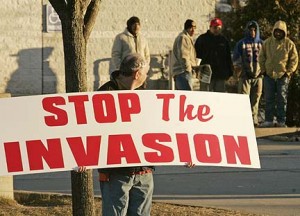
I believe that the following commentary on the necessity of law and order has some bearing on what is unfolding in Arizona—when the rules are not clearly written or consistently enforced, people will take the law into their own hands because society cannot run smoothly without law and order.
In Part 3 in my essay series on the relationship between rules, freedom, and prosperity, I want to turn to one of my favorite films, John Ford’s 1962 classic, The Man Who Shot Liberty Valance, in which a clash of moralities unfolds in the wild-west frontier town of Shinbone, Arizona. There in the dusty streets and ramshackle buildings two self-contained and self-consistent moral codes come into conflict. One moral code is the Cowboy Ethic, where trust is established through courage, loyalty, and personal allegiance to friends and family, and where disputes are settled and justice is served between individuals who have taken the law into their own hands. The other moral code is the Law Ethic, where trust is established through the transparent and mutually-agreed upon rule of law, and where disputes are settled and justice is served between all members of the society who, by virtue of living there, have tacitly agreed to obey the rules. Only one of these moral codes can prevail. Continue reading…
comments (60)
by
Michael Shermer, Feb 23 2010
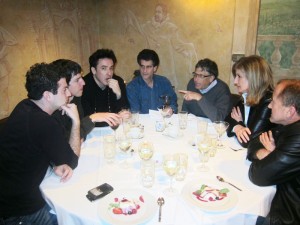
left to right: Jared Cohen, Dave Morin, John Cusack, Dean Kamen, Bill Gates, Arianna Huffington, Michael Shermer. (All photos in this post were taken by John Brockman.)
No, it wasn’t exactly My Dinner with Andre—the classic 1981 filmed conversation between Wallace Shaun and Andre Gregory (directed by Louis Malle) that ranged across a diversity of existential topics—but listening to Bill Gates hold forth on matters of business, economics, finance, world health, education, and nutrition and physical fitness in a dinner arranged by John Brockman’s Edge.org during last week’s TED gathering in Long Beach was a memorable experience nonetheless.
Richard Dawkins once said that John Brockman has the most stellar rolodex in all of science, and periodically Brockman organizes an Edge.org event that brings them all together for some serious dialogue about the great issues of our time. There were around 80 people in all, which soon broke up into small groups of schmoozing and social networking. Check out the roster and accompanying photos.
When it was time to sit down for dinner there was a spot open at the Gates table (we’ll call it), that included some heavyweights such as Facebook’s Dave Morin, the Segway inventor Dean Kamen, the actor John Cusack, Jared Cohen from the U.S. State Department, Michael Tchao, VP of Apple’s new iPad division, Arianna Huffington of HuffingtonPost, Bill Gates, and your humble servant. Continue reading…
comments (87)
by
Michael Shermer, Feb 09 2010
President Barack Obama has unveiled his new budget for fiscal year 2011 at $3.8 trillion dollars. Staggeringly huge. Brobdingnagianly big. Almost inconceivable. Just how much is a trillion dollars? Here are some comparisons.
The brain consists of about a hundred billion neurons, which is about the same as the number of stars in the Milky Way galaxy. A hundred billion is 1011, or a 1 following by 11 zeros: 100,000,000,000. That’s about what Obama plans to spend on Veterans Affairs ($57 billion) and Homeland Security ($43 billion) combined. It’s a huge number. It is literally an astronomical number. But that’s nothing. A trillion is a thousand billion. How much is a trillion? Continue reading…
comments (149)
by
Michael Shermer, Oct 13 2009
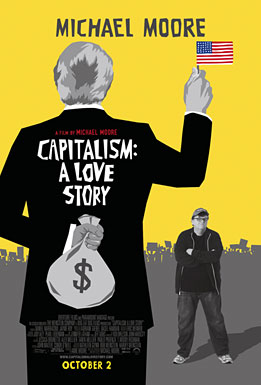
Michael Moore is the Leni Riefenstahl of our time. Or, perhaps he would be better characterized as a Bizzaro World Leni Riefenstahl, because while she propped up with propaganda the political powers of her time, Moore uses the same techniques to bring down the powers of our time, be it GM (Roger and Me), the gun lobby (Bowling for Columbine), the government (Fahrenheit 911), the health care industry (Sicko), or free enterprise (Capitalism: A Love Story).
In this latest installment in his continuing series of what’s wrong with America, Michael Moore takes aim at his biggest target to date, and the result is a disaster. The documentary is not nearly as funny as his previous films, the music selections seem contrived and flat, and the edits and transitions are clumsy, wooden, and not nearly as effective as what we’ve come to expect from the premiere documentarian (Ken Burns notwithstanding) of our time. And, most importantly, the film’s central thesis is so bad that it’s not even wrong. Continue reading…
comments (218)
by
Michael Shermer, Oct 06 2009
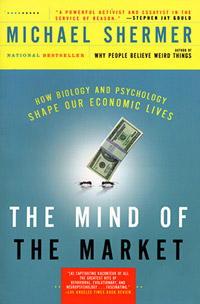
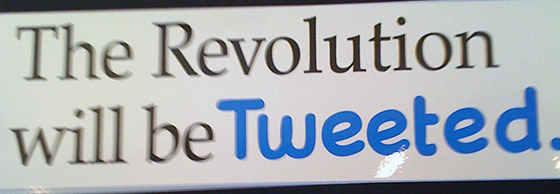
At the Atheist Alliance International conference this past weekend in Burbank, California, the Skeptics Society had a booth in the vendor’s section of book sellers and the like, the latter of which included a table full of bumper stickers. One struck me as a poignant proxy for what I predicted will happen at the end of my book, The Mind of the Market: the Internet as a form of trade will enable freedom to find a way. The bumper sticker reads: The Revolution Will be Tweeted. I presume the reference is to the Iranian elections, the suppression of the protests of the corruption of which were tweeted.
 Continue reading…
comments (14)
by
Michael Shermer, Jul 28 2009
So many of you have taken the time to respond to my blogs thoughtfully that I feel I should comment in kind. In looking through the many comments, however, I see that most of what I would say has already been said by people who responded to my critics. Nevertheless…
First of all, why is it okay to mix science and religion (with atheists eagerly do in debunking religious claims) but not okay to mix science and politics/economics? Why is it okay for liberal atheists to stick it to religious believers and twist the knife slowly, but when it comes to getting your own (political/economic) beliefs challenged, that’s off limits — NOMA (nonoverlapping magisterial) for science and politics? I don’t see how they are different in principle. Skeptic is a science magazine, not an “atheist” magazine; nevertheless, we routinely deal with religious claims and no one ever complains about that. The closest we have come to political/economic issues is environmentalism (Vol. 9, No. 2 — sold out), overpopulation (Vol. 5, No. 1), and global warming Vol. 14, No. 1). For all three we published several articles; in Vol. 14, No. 1, for example, we published articles both skeptical of global warming and accepting of global warming. So I don’t see what would be wrong with publishing articles pro, con, and neutral on political and economic claims. Continue reading…
comments (266)
by
Michael Shermer, Jun 09 2009
On Thursday June 4, I attended the Cato Institute half-day conference in Century City, California, which started out with a lecture by U.C. Santa Barbara evolutionary psychologist Leda Cosmides, one of the founders of that science along with her husband John Tooby. Cosmides’ talk was on the evolution of cooperation, but for this audience she tailored her lecture toward politics and economics (Cato is a libertarian think tank in D.C.), by asking “Why do free societies arise so rarely and with such difficulty?”
Unfortunately, Leda tried to squeeze about two hours of material and powerpoint slides into a 35-minute talk, and so she was necessarily brief as she blasted through slide after slide, each up on the screen for only seconds, making note taking impossible. That’s too bad because there was a lot of data slides that I think the audience would have liked to absorb (I know I would have). Nevertheless, Leda’s central point was this: our brains evolved for solving specific problems in the EEA (the Environment of Evolutionary Adaptation — the Paleolithic), and so we have domain specific programs that help organize our experiences. The problem is Continue reading…
comments (131)
by
Michael Shermer, Dec 09 2008
With the market meltdown of the past year those of us who are long-time supporters of the freedom of markets have by now heard the refrain: “What do you say now?” or “So much for your mighty market economics” and especially “See, deregulation doesn’t work.”
Let’s dispense with the “deregulation” myth right here. The list of new regulations called the Federal Register averaged 72,844 pages during the Carter administration, 54,335 pages during Reagan’s presidency, climbed to 59,527 pages for Bush the First, escalated during the Clinton years to 71,590 pages, and set an all-time record during Bush the Second at 75,526 pages, supposedly the era of deregulated markets run amok. So much for the Republicans as the party of government nonintervention. Continue reading…
comments (270)
by
Michael Shermer, Oct 28 2008
Treating Wall Street and the financial industry like professional sports brings a new perspective to the motivation of traders and financers
In the midst of our financial crisis it was inevitable that there would be references to the 1987 film Wall Street, in which Michael Douglas’s character Gordon Gekko explains what really drives market capitalism: “The point is, ladies and gentleman, that greed — for lack of a better word — is good. Greed is right. Greed works. Greed clarifies, cuts through, and captures the essence of the evolutionary spirit. Greed, in all of its forms — greed for life, for money, for love, knowledge — has marked the upward surge of mankind. And greed — you mark my words — will not only save Teldar Paper, but that other malfunctioning corporation called the USA.” Continue reading…
comments (53)