Skepticblog
About Michael Shermer

Dr. Michael Shermer is the Founding Publisher of Skeptic magazine, the monthly "Skeptic" columnist for Scientific American, and author of Why people Believe Weird Things, an exploration into a variety of strange ideas, groups and cults. A psychologist, professor and historian of science, Dr. Shermer was also the co-producer and co-host of the Fox Family television series, Exploring the Unknown. Dr. Shermer has made countless appearances on television including, Oprah, Larry King Live, The Colbert Report, Dateline, 20/20, The History Channel, A&E, The Discovery Channel, and PBS as a skeptic of weird and extraordinary claims.
RSS feed for this author
www.michaelshermer.com
www.skeptic.com
Subjects
aliens alternative medicine atheism autism belief bigfoot Brian Dunning CAM Carl Sagan climate change conspiracy theories Creation creationism critical thinking cryptozoology denialism dinosaurs Dr. Kiki earthquakes economics education environment ethics evolution fossils geology Ghost Hunting ghosts global warming God homeopathy intelligent design james randi journalism media medicine michael shermer morality nasa paleontology paranormal politics pseudoscience Psychics psychology religion science science denialism scope SETI Shermer skeptical history skepticism skeptoid Skeptologists TV ufo ufos vaccines videoRecent Comments
- Daniel Loxton commented on A Fond Farewell to Skepticblog at 1:25 pm, September 18, 2014
- markx commented on A Fond Farewell to Skepticblog at 8:52 pm, September 17, 2014
- Thomas commented on False Equivalence at 11:44 am, September 15, 2014
- John Greg commented on A Fond Farewell to Skepticblog at 2:10 pm, September 13, 2014
- tmac57 commented on A Fond Farewell to Skepticblog at 10:39 am, September 13, 2014
Read posts by author:
What Should We Be Worried About?
The following article was first published on Edge.org on January 13, 2012 in response to this year’s Annual Question: “What Should We Be Worried About?” Read Michael Shermer’s response below, and read all responses at edge.org.
The Is-Ought Fallacy of Science and Morality
Ever since the philosophers David Hume and G. E. Moore identified the “Is-Ought problem” between descriptive statements (the way something “is”) and prescriptive statements (the way something “ought to be”), most scientists have conceded the high ground of determining human values, morals, and ethics to philosophers, agreeing that science can only describe the way things are but never tell us how they ought to be. This is a mistake.
We should be worried that scientists have given up the search for determining right and wrong and which values lead to human flourishing just as the research tools for doing so are coming online through such fields as evolutionary ethics, experimental ethics, neuroethics, and related fields. The Is-Ought problem (sometimes rendered as the “naturalistic fallacy”) is itself a fallacy. Morals and values must be based on the way things are in order to establish the best conditions for human flourishing. Before we abandon the ship just as it leaves port, let’s give science a chance to steer a course toward a destination where scientists at least have a voice in the conversation on how best we should live.
We begin with the individual organism as the primary unit of biology and society because the organism is the principal target of natural selection and social evolution. Thus, the survival and flourishing of the individual organism—people in this context—is the basis of establishing values and morals, and so determining the conditions by which humans best flourish ought to be the goal of a science of morality. The constitutions of human societies ought to be built on the constitution of human nature, and science is the best tool we have for understanding our nature. For example (continue reading…)
comments (52)Coincidences and Certainties
On the morning of Friday, November 16, 2012, I wandered out of my hotel in Portland, Oregon—The Crystal Hotel, an exotic boutique hotel with rooms decorated in the theme of a musician, poet, or artist (I stayed in the Allen Ginsberg room staring at a portrait of the beat poet and realized why I write nonfiction). In search of breakfast, I could have turned left or right as I exited the lobby. I turned right. At the first intersection I could have continued straight, gone left, or gone right. I went left. There were breakfast restaurants on both the left and the right side of the street. I chose one on the right. The hostess asked if I wanted to be seated near the window or next to the wall. I chose the window. About half way through my breakfast I happened to look up to see a man walking by who looked familiar. He looked at me with similar familiarity. I waived him into the restaurant. He spoke my name in recognition. I stuttered and stammered and hemmed and hawed and finally admitted, “I’m sorry, but I can’t remember your name.” He said, “Uh, Michael, it’s me, Scott Wolfman, your agent!” (continue reading…)
comments (27)God, ET, and the Supernatural
Why there cannot be a deity beyond the natural world
that science can discover
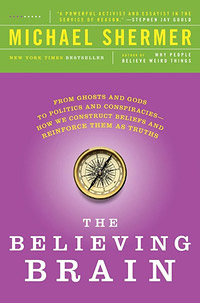
On Saturday, November 3, 2012 I spoke at the big atheists’ conference in Mexico City on The Believing Brain, my latest book in which I develop a theory to explain not just why people believe weird things, but why people believe anything at all, including and especially god beliefs. (I don’t know if the talk will be posted Online but it is an expanded version of my TED talk or this longer version.
In the audience was the biologist Jerry Coyne, the author of one of the best defenses of evolutionary theory ever penned: Why Evolution is True. He posted a blog about my lecture in which, surprisingly (given his staunch militancy for atheism), he expressed a difference with me in the possibility of there being a God. He writes:
While I respect Shermer’s view that invoking aliens or some unknown explanation avoids a “god of the gaps” argument for unknown and miraculous or divine phenomena, I still feel as a scientist that the existence of a true supernatural god is a theoretical possibility, and that there is some possible evidence that could convince me of it. (I’ve described that evidence before; needless to say, none has been found.) Yes, such miraculous evidence for a god might eventually be found to be due to aliens or the like, but my acceptance of a god would always be a provisional one, subject to revision upon further evidence. (We might find aliens behind the whole thing.) After all, every scientific “truth” is provisional.
Jerry’s allusion to alien gods is in reference to my brief summary in the Q&A of what I originally proposed in a 2002 Scientific American column entitled “Shermer’s Last Law” (title written with tongue firmly in cheek because naming laws after oneself is a sure sign of crankdom (continue reading…)
comments (19)Why Ayn Rand Won’t Go Away
Atlas Shrugged, Part 2
and the Motor of Moral Psychology
This article was originally published on HuffingtonPost.com on October 12, 2012
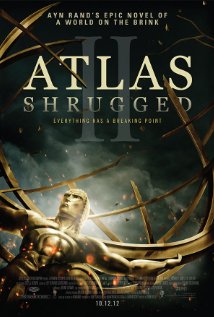
After seeing the Los Angles premiere of Atlas Shrugged, Part 2, the film that opened October 12 based on the 1957 novel by Ayn Rand (and with an entirely new cast and higher production values a vast improvement over Part 1), a question struck me as I was exiting the theater surrounded by Hollywood types most commonly stereotyped as liberal: Why don’t liberals admire Ayn Rand and her philosophy of objectivism, so forcefully presented in this book and film?
It is not a mystery that the woman who called herself a “radical for capitalism” would be embraced by some conservatives such as Paul Ryan and Ron Paul, but why do liberals not recognize that Rand was also a champion of individual rights, was outspoken against racism, bigotry and discrimination against minorities, and most notably was ahead of her time in championing women’s rights and demonstrating through her novels (and films) that women are as smart as men, as tough-minded as men, as hard working as men, as ambitious as men, and can even run an industrial enterprise as good as—if not better than—men? In the teeth of a 2010 study that revealed Hollywood still discriminates against women when it comes to roles in films, most notably the number and length of speaking parts and the continued blatant sexuality in which women show far more skin than men but speak far less, the hero of Atlas Shrugged, Dagny Taggert (played by Samantha Mathis in the new film), has the most speaking roles (and shows almost no skin), runs her own transcontinental railroad, handles with ease both seasoned male politicians and hard-nosed male titans of industry, and embodies courage and character deserving of respect and admiration from women and men, liberals and conservatives. (continue reading…)
comments (159)What is a “Fair Share” in Paying Taxes, Anyway?
In 2011 Mitt Romney paid $1,935,708 in taxes and made $4,020,772 in donations to charity, presumably most of it to the Mormon Church. Did Mitt Romney pay his fair share of taxes? That depends on how one defines “fair,” which we can think of in two uses: (1) fair value for services rendered; (2) fair percentage of earned income.
- Fair value for services rendered. For what amounts to roughly the same services rendered by the government that I received in 2011 (military, police, fire, roads and infrastructure, courts, and other essential services, along with future promises we both hope will be honored—Medicare, Medicaid, and Social Security), then Mitt paid almost two orders of magnitude more in taxes than I paid. And, presumably, I got everything from the government that Mitt got (except for Secret Service protection because I’m not running for President), or at least in the ballpark. So, by this definition of “fair,” it seems not unreasonable to ask: why should Mitt pay so much more than me when he doesn’t get additional police and fire protection, better roads and bridges, superior courts, and the like, than I receive for my much lower taxes? Almost no one accepts this definition of “fair,” but it’s worth thinking about as an exercise in critical thinking about how society should be structured. If Mitt and I lived on the same block why should he have to pay so much more for the same road on which we both drive? Is Mitt’s house going to get extra special fire protection from the local fire department because he paid more than I did? If we both sent our kids to the same public school, do Mitt’s kids get two orders of magnitude better education than my kids? The answer to all of these questions is obviously “no,” but why are we not asking these questions?
- Fair percentage of earned income. Mitt paid about 15% of his income in taxes. I paid about double that amount. Here we can turn the above questions around and ask why Mitt should only pay half of what I’m paying in percent of income for those same roads, schools, police and fire departments, courts, and the like? I’ll admit, it irritates a little that I’m paying so much more in percentage than Mitt, but I must also confessedly note that knowing Mitt paid almost two million in taxes attenuates that irritation considerably. Two million bucks is a lot of dough to hand over to bureaucrats in hopes that they do something useful with it.
So this entire topic turns on a simple definition of what we mean by “fair,” and that, in turn, seems to turn on what our goals as a society should be: equality of opportunity or equality of outcome? (continue reading…)
comments (187)What is Seen and What is Unseen
The Hidden Price of Immoral Acts
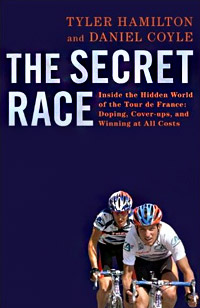
I’ve been reading Tyler Hamilton’s new book, The Secret Race: Inside the Hidden World of the Tour de France: Doping, Cover-ups, and Winning at All Costs, co-authored by Daniel Coyle, a journalist and author with considerable literary talent. It’s a gripping story about how Tyler Hamilton, Lance Armstrong, and all the other top cyclists have been doping for decades, using such advanced scientific programs of performance enhancement that estimates show the benefit could be as much as 10%, in races won by fractions of 1%. After nearly two decades of racing with both dope and no dope, Hamilton concludes that although a clean rider might be able to win a one-day race, it is not possible to compete in, much less win, a 3-week event like the Tour de France.
The lengths these guys go to win are almost beyond comprehension. All you do is train, eat, and sleep. And dope. The drug of choice is (or was—now that the drug testers have caught up riders use other drugs that have similar effects) EPO, or erythropoietin, a genetically modified hormone invented by Amgen that stimulates the body to produce more red blood cells, a life-saver for anemic patients undergoing chemo or suffering from other long-term ailments. Also on the menu is testosterone, human growth hormone, steroids (for injuries, not bulk, since cyclists get as skinny as they can), and others. Tyler nicknamed his EPO Edgar, as in Allen Poe. The drugs worked, he says, but only if (continue reading…)
comments (47)Mystery UFO Photo
I thought I would share with you an email and photographs submitted to me by a gentleman named Marc Richard. Instead of telling you what I think it is, I’d like to hear from you what you think is the best explanation. Submit your best guess in the comments section below.
comments (89)Hello, I’m not sure where to send these, or if your even looking for this kind of thing, couldn’t find a submissions page on the site. I have eight photos, I’ll send you two, if your interested I’d be happy to send the rest. Here’s what I wrote about the photos at the time I took them:
“On Oct, 19, 2009 at around 6:30pm, I was working on the 18th floor of my apartment building in downtown Detroit, when I noticed something floating around the two smoke stacks on the power plant near my place. It seemed to be hovering directly through the smoke of the stacks, and then around the two stacks, in between the two stacks, and then it would float a few blocks away and then back to the stacks. At this point I had been watching this thing for about 8 minutes or so when I ran to grab my camera and returned with my girlfriend and my brother in law. So I snapped off these pics which I can’t explain. It seems to be pretty small (about the size of one of those little smart cars?) I sent these photos to UFOs Northwest shortly after taking them. They’re still up on that site, nobody seems to have an explanation for them. If you have any questions I’d be happy to try and answer them.” (continue reading…)
The Muddle of Truth
What Really Happened on Fox’s TV show Moment of Truth:
Travis Walton responds to Michael Shermer
EDITOR’S NOTE: This article by Travis Walton explains his side of what happened on this dreadful Fox television show on which I also appeared and described in last week’s Skepticblog. To understand Walton’s explanation you should read that article first, but if you don’t have time the upshot of the story is that Travis Walton claims that on November 5, 1975 he was abducted into a UFO in an Arizona national forest during a logging job and that his co-workers witnessed the event. According to the late UFO investigator Philip Klass, Walton passed one polygraph test (published) but failed another (unpublished), and in his opinion Walton and his associates made up the story as an excuse for failing to complete the logging job on time. Walton’s side of the story is recounted in detail in his 1978 book The Walton Experience, later reissued as Fire in the Sky, the title of the 1993 film based on the book. —Michael Shermer
With the recent airing overseas of the canceled Fox television show, Moment of Truth some people may have been mislead into believing that some shocking new revelation about the famous logging crew UFO case has come to light. Quite the contrary. Now that the airing of the show ends the “gag clause” in my contract (with its $1 million penalty) I am free to reveal that Moment of Truth has used testing methods that the producers were informed from the beginning were long ago completely discredited by every polygraph expert, lie detector school, and polygraph professional association in existence. I’ll quote here specific condemnations of the show’s methods by four of the world’s most highly respected polygraph experts who agree: “the polygraph aspect of the show has no validity whatsoever.” I will reveal other blatant deceptions the show has committed. And I will provide details of how, after the show, I underwent two of the most rigorous new polygraph tests available anywhere in the world.
I should have seen it coming. I should have known better. But there were unique circumstances. (continue reading…)
comments (37)
Travis Walton’s Alien Abduction
Lie Detection Test
A Moment of Truth (or not) for the most famous
UFO abduction case in history
Because I have a teenage daughter I am relatively current on what’s popular in pop culture. American Idol is the ne plus ultra in the reality television genre (don’t let yourself get hooked), and because Fox incestuously promotes its other shows I was vaguely familiar with The Moment of Truth, a game show in which contestants have to tell the truth under the watchful wires of a lie detector in order to win cash prizes. Contestants are put through a battery of questions while hooked up to the polygraph, but are not told whether the examiner determined from the readings whether or not they told the truth. Later, in front of millions of viewers and a live studio audience, with their friends, co-workers, family, spouses, or boyfriends and girlfriends (or ex’s) sitting on the set with them, they are asked the same questions again. After each answer a female voice says “That answer is…” and after a long pause a “true” means the contestant continues up the ladder to $25,000, $100,000, $200,000 all the way to half a million bucks. A “false” sends you packing for home.
One night a woman was faced with her husband and ex-boyfriend and was asked if she wished she had married the other guy. “Yes,” she said. “That answer is…true,” sounded the voice. She won the money but lost the husband. I remember thinking to myself, “you’d have to be a real pinhead to go on this show.”
On July 31, 2008, I appeared on The Moment of Truth (watch Part 1 on YouTube. I appear at about 7 min. 35 secs. in Part 2.) The contestant was Travis Walton, arguably the most famous alien abductee in Earth history. (continue reading…)
comments (59)
In this year’s annual Edge.org question “What should we be worried about?” I answered that we should be worried about “ The Is-Ought Fallacy of Science and Morality.” I wrote: “We should be worried that scientists have given up the search for determining right and wrong and which values lead to human flourishing”. Evolutionary biologist and philosopher of science Massimo Pigliucci penned a thoughtful response, which I appreciate given his dual training in science and philosophy, including and especially evolutionary theory, a perspective that I share. But he felt that my scientific approach added nothing new to the philosophy of morality, so let me see if I can restate my argument for a scientific foundation of moral principles with new definitions and examples.
First, morality is derived from the Latin moralitas, or “manner, character, and proper behavior.” Morality has to do with how you act toward others. So I begin with a Principle of Moral Good:
You can, of course, act in a way that has no effect on anyone else, and in this case morality isn’t involved. But given the choice between acting in a way that increases someone else’s moral good or not, it is more moral to do so than not. I added the parenthetical note “through force or fraud” to clarify intent instead of, say, neglect or acting out of ignorance. Morality involves conscious choice, and the choice to act in a manner that increases someone else’s moral good, then, is a moral act, and its opposite is an immoral act. (continue reading…)
comments (78)